There is a specific kind of heartbreak known only to gardeners: walking out to your backyard after a summer storm to find your prize-winning "Cherokee Purple" tomato plant snapped under its own weight, or your cucumber vines sprawling hopelessly in the mud. As we look toward the 2026 gardening season, the industry is seeing a massive shift in how we handle these challenges. Industry forecasts for 2026 indicate that 78% of home gardeners are shifting toward multi-functional garden structures that offer both vertical plant support and natural privacy screening. We aren't just growing food anymore; we are architecture-building in our own green spaces.
To build a sustainable DIY trellis that stands the test of time and weather, the secret lies in the combination of material and technique. Use 4 to 6-foot bamboo poles secured with waxed lacing twine. For vertical stability, you must master the square lashing for cross-panels and transom knots for X-shaped joints. These specific technical lashing knots provide the tension needed to support heavy fruit like tomatoes and squash, and utilizing them can increase the weight-bearing capacity of a DIY bamboo frame by up to 40%, preventing collapse during peak harvest periods.
In this guide, we will explore the three most versatile DIY trellis designs: the cage trellis (best for tomatoes and dahlias), the tripod tepee (ideal for beans and peas in windy areas), and the A-frame (perfect for space-efficient vertical growth of cucumbers and melons).
The Sustainable Advantage of Bamboo
When I’m planning a renovation, whether it’s a kitchen backsplash or a garden layout, I always look for the "aesthetic neutral"—a material that does the job without clashing with the existing environment. Bamboo is the gold standard for sustainable gardening. It is incredibly strong for its weight, naturally rot-resistant for several seasons, and has a sleek, organic look that complements any landscape from modern minimalist to rustic cottage.
Beyond aesthetics, bamboo offers a level of reusability that plastic-coated metal stakes simply can’t match. Because these structures are held together with twine rather than permanent screws or glue, you can deconstruct them at the end of the season. This allows for total customization; you might build a tall A-frame for your beans this year and then repurpose those same poles into a series of tomato cages next year to suit your crop rotation. It’s a circular system that respects both your budget and the planet.
Essential Materials and Tools
Before we get our hands dirty, let’s talk about your shopping list. Quality matters here. If you start with brittle, thin poles, your trellis will be a one-season wonder.
- Bamboo Poles: Aim for 4 to 6-foot lengths with at least a 1-inch diameter for the main structural "legs."
- Waxed Lacing Twine: This is a pro-secret. Standard jute twine rot quickly and stretches when wet. Waxed twine (often used in leatherwork or sailing) grips the bamboo and stays tight regardless of the humidity.
- Measuring Tape: Precision in your cross-bar placement ensures the weight is distributed evenly.
- Timber Saw: A fine-toothed saw is essential for clean cuts.
The Pro Swap: If you can't find bamboo locally, look for hazel poles or even upcycled straight branches from a recent tree pruning. This gives your garden a "coppiced" look that is very popular in traditional English gardens.
While it might be tempting to use standard garden shears to cut your poles, I strongly recommend a timber saw. Bamboo is a grass, not a wood, and its fibers are prone to splintering. A sharp, fine-toothed saw prevents the ends from cracking, which ensures your lashing knots have a solid, non-slip surface to grip.
Master the Foundation: The Science of Garden Knots
In DIY, the "how" is just as important as the "what." Most trellis failures happen at the joints. When a plant like a Hubbard squash starts putting on weight, it exerts downward and outward pressure. If you just wrap twine around the poles haphazardly, the cross-bars will eventually slide down the smooth surface of the bamboo.
Square Lashing is your best friend for 90-degree joints. You begin with a clove hitch on the vertical pole, then wrap the twine over and under the horizontal pole in a "square" pattern. The magic happens during the "frapping"—where you wind the twine between the poles to pull the previous loops tight. This creates a mechanical tension that prevents sliding.
Transom Knots are the go-to for X-shaped joints, like the top of a tripod or an A-frame. It’s a simple but powerful knot that tightens as weight is applied to the structure. By mastering these two techniques, you ensure your trellis can handle the 40% increase in weight-bearing capacity mentioned earlier. It’s the difference between a structure that wobbles in a breeze and one that feels like a solid piece of furniture.
Design #1: The Enclosed Cage Trellis
Forget those flimsy wire cones you find at big-box stores. They are rarely tall enough for indeterminate tomatoes, which can easily reach 7 or 8 feet. The bamboo cage trellis is a four-legged "box" structure that provides support from all sides.
- Set the Legs: Drive four 6-foot bamboo poles into the ground in a square formation, roughly 18 inches apart. Ensure they are buried at least 10-12 inches deep for stability.
- Add the First Tier: Measure 18 inches up from the ground. Use square lashing to attach four horizontal bamboo pieces (cut to fit) to the legs.
- Repeat: Add a second and third tier of horizontal bars every 18 inches.
This design is perfect for indeterminate tomatoes and dahlias. As the plant grows, you simply tuck the branches inside the "cage." The horizontal bars provide plenty of places for the heavy fruit to rest, taking the strain off the main stem.
Design #2: The Tripod Tepee
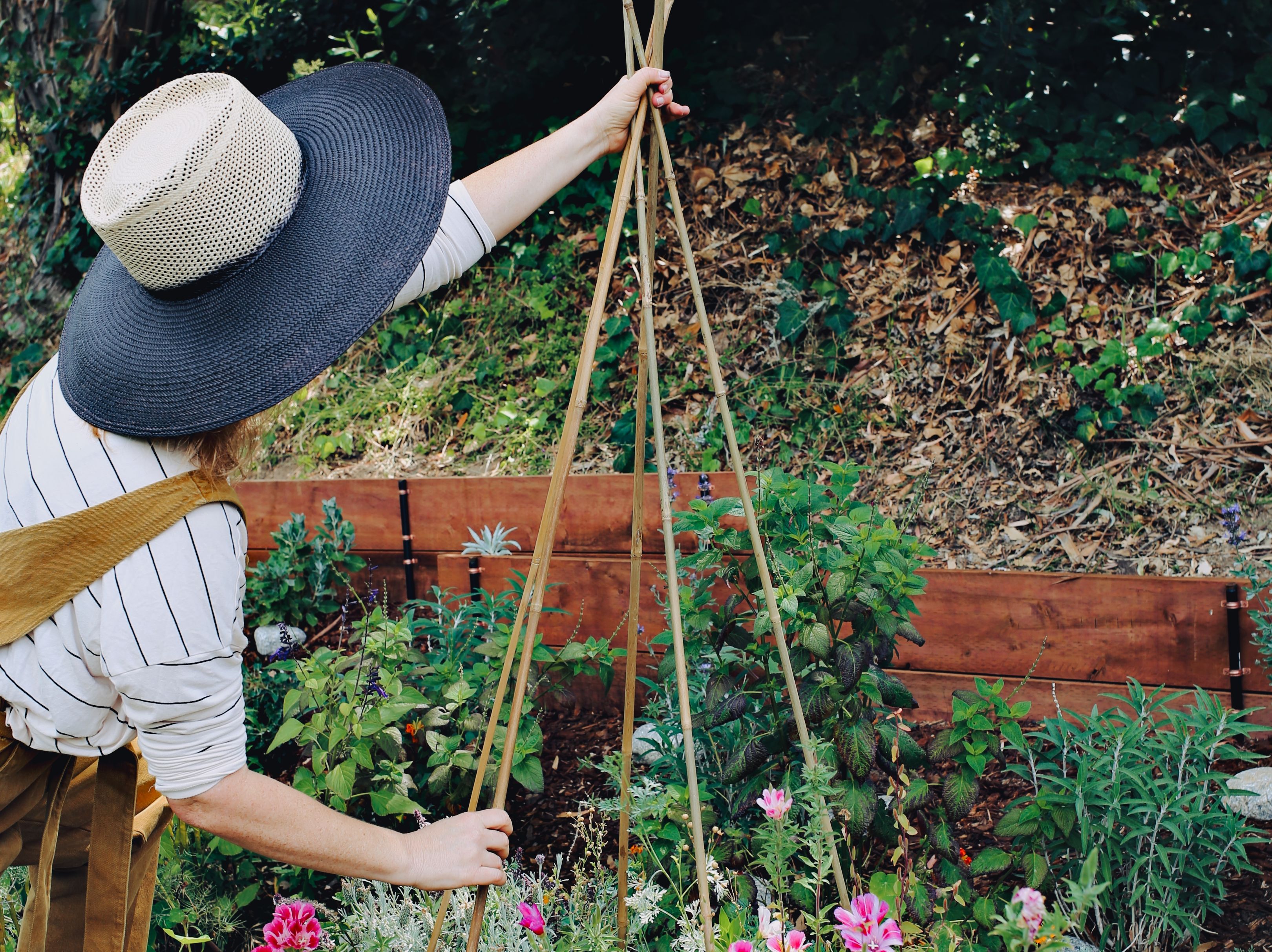
The tripod is perhaps the most iconic garden structure. It’s incredibly stable because it has a low center of gravity and a wide base, making it the ideal choice for windy micro-climates or exposed backyard plots.
To build this, take three poles of equal length and lay them flat on the ground. Use a transom knot to lash them together about 6 inches from the top. Stand the structure up and pull the legs apart to form a stable pyramid.
For plants like beans and peas, which use "twiners" to climb, the smooth bamboo can sometimes be hard to grab.
- Pro-Tip: Create lateral "grabbing points" by wrapping horizontal loops of twine around the tripod every 6 inches. This creates a "ladder" for the vines to follow as they reach for the sun.
Design #3: The Versatile A-Frame
If you are dealing with heavy lifters like cucumbers, squash, or melons, the A-frame is your strongest option. It works like a tent, with two slanted sides meeting at a ridge pole.
| Feature | A-Frame Specification |
|---|---|
| Best For | Heavy fruit, high-yield vertical growth |
| Footprint | 4ft x 3ft (Standard) |
| Weight Capacity | Up to 50 lbs of produce |
| Material Use | High (Requires 7-9 poles) |
Construction involves creating two "A" shapes at either end and connecting them with a long ridge pole at the top. You can then customize the sides. For cucumbers, I recommend running vertical lines of twine from the ridge pole to the ground. For heavier squash, you might want to lash horizontal bamboo cross-bars to create a rigid grid. The beauty of the A-frame is the "under-space"—it creates a shaded tunnel where you can plant heat-sensitive crops like lettuce or spinach, maximizing every square inch of your garden.
2026 Trend: Integrating Privacy with Production
One of the most exciting trends we’re seeing for 2026 is the blurring of lines between the "edible garden" and the "living room." Homeowners are scaling these bamboo designs to create natural privacy screens for balconies and patios.
Imagine a series of tall A-frames or Cages lined up along the edge of a deck. By planting fast-growing climbers like Scarlet Runner Beans or even ornamental hops, you create a lush, green wall that blocks the neighbor's view while providing a harvest. To stay on-trend with 2026 color palettes, try pairing the natural tan of the bamboo with sage green foliage, silver-leafed herbs, and soft white blooms. It creates a serene, high-end look that feels more like a curated outdoor "room" than a utility plot.
FAQ
Q: How do I prevent the bamboo from rotting in the soil? A: While bamboo is naturally rot-resistant, you can extend the life of your poles by dipping the bottom 12 inches in eco-friendly wood preservative or even melted beeswax before driving them into the ground.
Q: My twine keeps slipping on the smooth bamboo. What am I doing wrong? A: This usually happens if you aren't using "frapping" turns in your knots. After you’ve made your initial loops around the poles, you must wind the twine between the poles to pull everything together. Also, ensure you are using waxed twine, which has much more "bite" than standard string.
Q: Can I leave my bamboo trellis out over winter? A: In mild climates, yes. However, in areas with heavy snow or high moisture, it’s best to deconstruct it. Untie the twine, dry the poles, and store them in a garage or shed. This will double the lifespan of your materials.
Building your own garden supports isn't just a weekend project; it's an investment in your garden’s health and your own DIY skills. There is a profound sense of pride in seeing a harvest hanging from a structure you built with your own hands. So, grab your bamboo, practice those knots, and get ready for your most productive season yet.
Ready to transform your garden? Start by sketching out your layout and deciding which of these three designs fits your space. Whether you're building a privacy screen or a tomato tower, remember: a sturdy foundation today means a better yield tomorrow.