What are the must-have tools a new homeowner needs to start tackling basic DIY projects?
A starter kit for new homeowners that pairs the right tools with the projects you'll actually try first, plus how to match your kit to your skill level and storage space.
Start with a core set of hand tools (hammer, screwdrivers, tape measure, level, pliers, adjustable wrench, utility knife), add a cordless drill/driver as your first power tool, and choose storage and safety items that match the size of your home. Then add power tools and outdoor gear only when you have a real project in mind.
The shortest path to a useful starter kit is to match tools to the projects you'll actually try in the first year of ownership, not to the projects you might attempt someday. Most new homeowners underuse a bulky combo set and overuse a basic drill, a level, and a good tape measure. Build the kit in waves: a hand-tool foundation, one cordless drill/driver, basic painting and safety supplies, and only then specialty power tools and outdoor equipment.
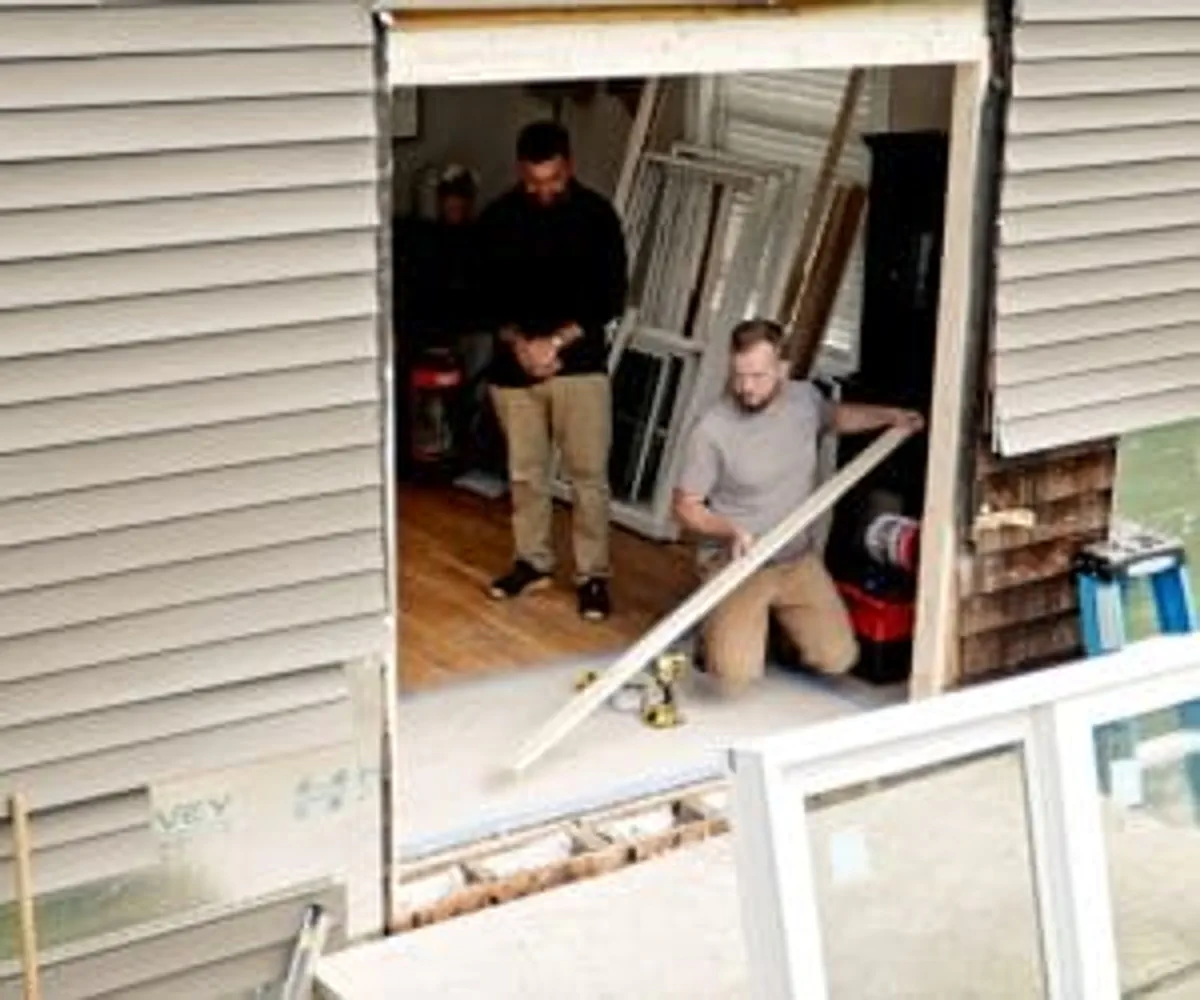
Before buying specialty tools, watch how a real renovation is staged: a window-to-door conversion shows how a single drill, level, and saw can carry a whole project.
Wave 1: The hand-tool foundation
Every starter kit shares the same hand-tool core. These are the tools you will reach for weekly, whether you're tightening a cabinet pull, opening a stubborn package, or stopping a small leak before it becomes a big one.
Core hand tools for a new homeowner
✓
Hammer (16 oz)
Drives nails, sets small anchors, and handles light prying. A 16-ounce claw hammer is the most versatile size for general household work.
✓
Screwdriver set with hex keys
Phillips and flathead in a few sizes, plus a basic hex/Allen key set. Covers outlet covers, furniture assembly, and most cabinet hardware.
✓
Tape measure (at least 16 ft)
16 feet handles most room-length measurements; 25 feet is helpful for furniture and floor plans. Look for a locking blade and a sturdy hook.
✓
Level (torpedo size)
A short magnetic torpedo level fits in a drawer and is accurate enough for shelves, pictures, and appliance leveling. Cheap levels are often inaccurate, so buy one you trust.
✓
Pliers assortment
Slip-joint, needle-nose, and tongue-and-groove (channel-lock) pliers cover gripping, bending, and basic plumbing. A matching pair of adjustable wrenches handles most nuts under the sink.
✓
Utility knife
Choose a retractable model with a locking blade and easy blade changes. Safer than a kitchen knife for opening boxes and scoring drywall.
✓
Stud finder
Magnetic or electronic, for safely mounting shelves, TVs, and heavy mirrors into wall studs rather than just drywall.
✓
Adjustable wrench (two sizes)
One 6-inch and one 10-inch covers most under-sink and furniture-assembly work without buying a full wrench set.
Wave 2: The first power tool, and why it's a drill
If you buy only one power tool, make it a cordless drill/driver. It replaces a screwdriver for 90% of fastening tasks, drills pilot holes and anchors, and mixes paint in a pinch. Pros across trades have moved almost entirely to cordless for everyday work, which is a strong signal for a homeowner who will use it less often.
Drill buying rules that actually matter
Buy a kit that includes two batteries and a charger, so you are never waiting on a charge mid-project.
Pick a battery platform (the brand family) you can grow into. Every future cordless tool you buy should share that battery.
An 18V or 20V max brushless model is the sweet spot for home use; 12V is fine for very light work, and 40V tools are overkill for most starter projects.
Add a small bit and driver set (drill bits, a few common driver bits, a small level, and a tape measure) so the drill is useful the day you open the box.
Wave 3: Painting and safety basics
Paint is the highest-leverage upgrade a new homeowner can make. A single accent wall, a refreshed bathroom, or a patched-and-painted room changes how a house feels for the cost of a few tools and a gallon of paint. Painting also rewards good prep, which is why the basics matter more than the brush.
Painting and surface-prep kit
✓
Angled sash brush (2 to 2.5 in)
Cuts clean lines along trim, ceilings, and corners. One good brush outlasts several cheap ones.
✓
Roller frame and covers
A 9-inch frame with a short-nap cover for smooth walls and a medium-nap cover for texture. Disposable tray liners save cleanup time.
✓
Painter's tape and drop cloths
Tape protects edges; canvas or plastic drop cloths protect floors. Buy more cloth than you think you need.
✓
Putty knife and spackle
For filling nail holes and small dings before painting. A 2-inch flexible putty knife handles most repairs.
✓
Safety basics
Safety glasses, a dusk mask or N95 for sanding and drywall work, and work gloves. These belong in the kit from day one, not added later.
Wave 4: Add power tools only when a project needs them
Power tools earn their keep on specific projects, not in the abstract. Match the tool to the work you can already see, not the work you imagine doing someday. A circular saw on a shelf is wasted money; a circular saw plus one weekend of building shelves is a good purchase.
Which power tool to add, and when
Tool
Buy it when you need to
Skip if
Circular saw
Cut plywood, build simple shelves, or frame a small wall project
You're only hanging pictures and assembling flat-pack furniture
Jigsaw
Cut curves, notches, or openings in sheet goods
All your cuts are straight
Orbital sander
Refinish furniture or prep walls for paint
You only do small touch-ups (spackle and a sanding sponge work)
Impact driver
Drive long screws or lag bolts repeatedly
A drill/driver handles every screw in your house today
Oscillating multitool
Make flush cuts, scrape grout, or trim door casings
You don't have a specific trim or remodeling project in mind
Wet/dry vacuum
Clean up after sanding, drywall, or shop projects
You do light indoor work only; a household vacuum handles it
Wave 5: Storage that fits your space
The right storage is the difference between a tool you use and a tool you lose. New owners often over-buy storage; a basic toolbox plus one wall-mounted system covers most needs for the first year.
Match storage to your home, not a dream garage
Apartment or small home: a hard-sided toolbox for the core kit plus a soft-sided tool bag for carrying jobs around the house.
House with a garage or basement: a roller cabinet or a pegboard wall for the power tools, with a small portable toolbox for everyday hand tools.
Shared with family: lockable storage keeps curious hands away from sharp blades and batteries.
Growing collection: freestanding shelving or wall-mounted racks for bulkier tools and paint supplies, so floor space stays clear.
Wave 6: Outdoor tools, sized to the yard
Outdoor tools are easy to over-buy. The yard tells you what you need: a small courtyard wants a hand pruner and a watering can; a quarter-acre lawn wants a mower and a rake. Match the kit to the property, not to a fantasy garden.
Outdoor kit by yard size
✓
Any yard
Bypass pruners for live wood, a garden hose with a shutoff nozzle, and a pair of work gloves.
✓
Small to medium lawn
A push or cordless electric mower, a leaf rake, and a shovel or spade for edging and planting.
✓
Larger property or heavier work
A self-propelled mower (gas or high-voltage cordless), a wheelbarrow, and a string trimmer for edges and fence lines.
Match the kit to your skill level
A beginner kit and an experienced DIYer kit look different, and pretending otherwise just wastes money. Beginners benefit from forgiving, low-cost tools that build confidence. Experienced DIYers benefit from better tools that hold up to frequent use and more demanding projects.
What changes at each skill level
Category
Just starting out
Comfortable with basic repairs
Hand tools
Buy a basic mixed set to cover the core list and replace individual tools as they fail
Buy each core tool individually, choosing brands you trust
Power tools
Skip most; one drill and a borrowed or rented saw is enough
Add a circular saw, jigsaw, and sander on a shared battery platform
Painting
A brush, a roller, tape, and a drop cloth
Add an extension pole, a small trim brush, and a quality 9-inch cover
Outdoor
Hand pruners, a rake, a basic mower
A cordless mower, string trimmer, and a wheelbarrow for bigger jobs
Storage
One toolbox and a small bag
A pegboard or a small roller cabinet plus a portable organizer
What to buy first, second, and third
A simple order of operations
01
Week 1
Buy the hand-tool core, a stud finder, a torpedo level, and a utility knife. Tag your main water shutoff and locate your breaker panel.
02
Month 1
Add a cordless drill/driver on a battery platform you can grow into, plus a small bit and driver set. Add safety glasses, a dust mask, and gloves.
03
Month 2 to 3
Add the painting kit: brush, roller, tray, tape, drop cloth, putty knife, and spackle. Paint or patch one room first to learn the workflow.
04
Months 4 to 12
Add power tools only when a real project shows up. Build storage around the tools you actually own, not the tools you plan to buy.
Quality vs. price, and when each makes sense
A few tools are worth buying once, at higher quality: a tape measure, a level, a utility knife, and a drill/driver. These are used often, and the price difference between a budget version and a reliable version is small compared to the cost of an inaccurate level or a dropped battery. For tools you'll use rarely, like a circular saw used once a year to break down cardboard, a budget pick is fine.
Spend more on tools you use weekly
Cordless drill/driver (the platform you build on).
Tape measure and level (accuracy matters; cheap versions drift).
Utility knife and blades (you'll use it more than you expect).
Pliers and adjustable wrenches (comfortable grips pay off on long jobs).
SUMMARY
The bottom line
A new homeowner's starter kit is a hand-tool foundation, one cordless drill/driver on a battery platform you can grow into, a basic painting and safety kit, and storage that fits your space. Add circular saws, sanders, and outdoor power tools only when a real project shows up. Match the kit to your yard, your skill level, and the size of your home, not to a fantasy tool collection. Buy the core tools once at decent quality, rent or borrow the specialty tools you need only once, and let the kit grow alongside your skills.
Common questions
Before you move on
What is the very first tool a new homeowner should buy?+
A cordless drill/driver on a battery platform you can grow into. It handles most fastening and light drilling tasks and replaces a screwdriver for the majority of household jobs.
How many tools does a new homeowner actually need?+
For most owners, a core of about 8 to 10 hand tools, one drill/driver, basic painting supplies, and safety gear is enough for the first year. Add specialty power tools only when a specific project requires them.
Should I buy a combo kit or individual tools?+
Buy a combo kit if it includes tools you would buy anyway on the same battery platform. Skip it if the kit is loaded with tools you won't use just to save on the drill and impact driver.
How do I know which tools to skip?+
If you cannot name a specific project in the next six months that needs the tool, skip it. Borrow, rent, or buy later when the project actually appears.
Do federal interstate moving rules affect what tools I should own?+
No. Federal interstate carrier rules govern how moving companies handle your belongings across state lines, not what you own or how you maintain your home. In-state moves are governed by your state's rules, which differ. Your tool kit is the same either way.