How much does home internet cost per month and what installation fees should I expect?
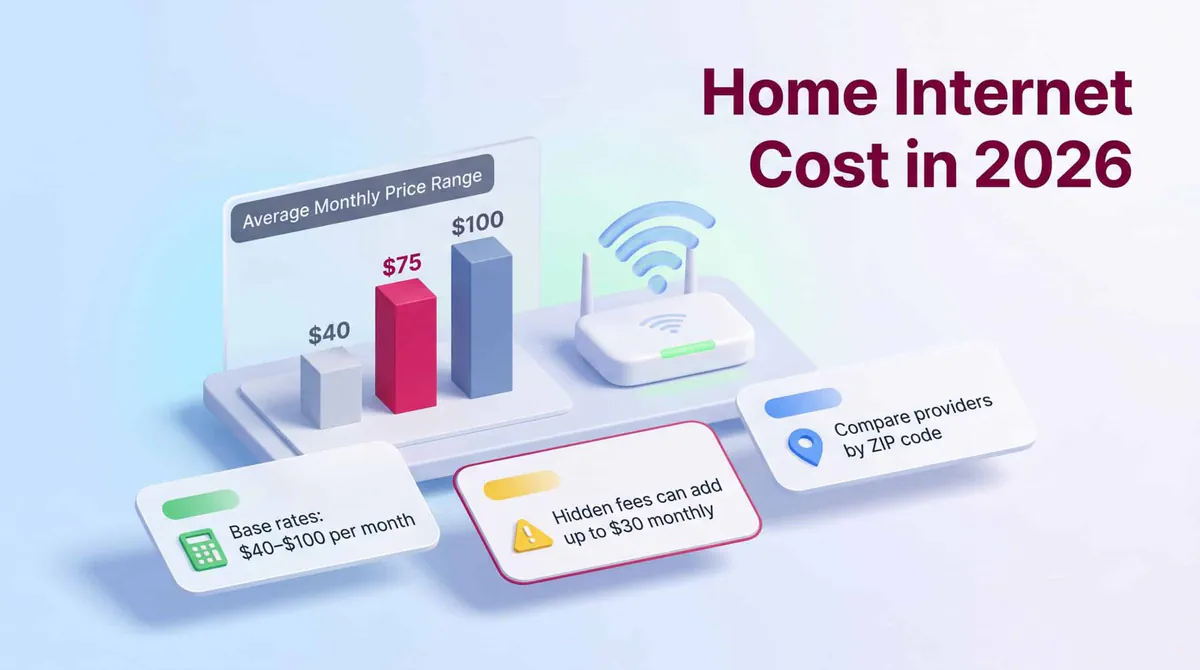
A 2026 household should plan for roughly $75 a month as a national midpoint, with most bills landing between $40 and $100. Add another $100 to $200 for typical installation, plus $5 to $15 a month if you rent a modem or router from your provider.
Expect a national average near $75 per month for home internet in 2026, with most households paying between $40 and $100 depending on connection type and provider. Budget $100–$200 for a standard professional installation, and add $5–$15 per month if you rent your modem or router instead of buying your own.
Internet is the utility most movers forget to price until move-in week, and it is the one with the widest swing in the budget. The national midpoint for a reliable broadband plan in 2026 is about $75 a month, and most households land somewhere in a $40 to $100 range. The bigger variables are not the advertised rate but the connection type at your address, the installation model your provider uses, and whether you rent or buy your equipment.
BroadbandNow's 2026 snapshot of the average base rate and the room hidden fees have to push your bill higher.
Monthly cost by connection type
The technology available at your address sets the floor and ceiling on price. Fiber and cable dominate urban and suburban blocks, fixed wireless and 5G home internet cover many suburban and small-town homes, and satellite is the default where nothing else reaches. Rural households often pay the most for the slowest service because the wired infrastructure is simply not there.
Typical 2026 monthly price by connection type
Connection
Typical monthly range
Maximum advertised speed
Best fit
Fiber
$65–$100
10 Gbps
Smart homes, heavy uploads, frequent video calls
Cable
$50–$80
2 Gbps
Standard streaming, remote work, mid-sized families
5G home internet
$35–$70
1 Gbps
Apartments and quick self-install moves
Fixed wireless
$40–$50
1 Gbps
Budget rural or suburban households
DSL
$40–$50
140 Mbps
Light use where nothing else is wired
Satellite
$110–$120
300 Mbps
Off-grid and rural homes with no wired options
Installation fees and equipment costs
Most professional installations for cable, fiber, DSL, and fixed wireless run $100 to $200. Satellite installations are heavier because the dish and mount need line of sight to the sky, so those can run $300 to $500 in labor. A few fiber providers, including Quantum Fiber, waive installation on standard jobs and only charge if the build at your address runs over a stated threshold.
Equipment and one-time costs to expect
Modem or router rental: $5 to $15 per month, or about $60 to $180 a year.
Buying your own compatible modem and router: usually $100 to $250 up front, which pays for itself in roughly a year.
Mesh extenders for larger homes: roughly $150 to $400 as a one-time add-on.
Satellite hardware kits: up to about $2,500 for traditional systems, though Starlink and similar LEO services have moved much of the hardware into a smaller upfront kit.
Activation or setup fees on top of installation: $0 to $50 with most major providers, occasionally folded into a first-month bill.
Most households now run multiple 4K streams and work calls at the same time, which is why the 300 Mbps plan is the new baseline for a family of four.
No-contract plans that move well
Annual contracts are no longer the norm, and the plans worth knowing for a move are the ones that pair a stable price with self-install hardware. Fixed wireless and 5G gateways typically arrive in the mail and skip the truck roll entirely, which is the fastest way to be online the day you get the keys.
Common no-contract plans to price against
Plan
Type
Starting price
Headline speed
T-Mobile Rely Home Internet
Fixed wireless / 5G
$50/mo with AutoPay
Up to 354 Mbps
Verizon Fios 300 Mbps
Fiber
$49.99/mo
Up to 300 Mbps
Quantum Fiber 500 Mbps
Fiber
From $50/mo plus tax
Up to 500 Mbps
Frontier Fiber 500
Fiber
$29.99/mo with AutoPay and paperless billing
Up to 500 Mbps
Optimum 300 Mbps Internet
Cable
$25/mo
Up to 300 Mbps
AT&T Fiber Internet 300
Fiber
$35/mo for 12 months
Up to 300 Mbps
A simple setup plan for move week
01
Check availability at your new address 2 to 3 weeks out
Run a ZIP code search for fiber, cable, and fixed wireless. If only one provider shows up, that is your price ceiling and your leverage is limited.
02
Pick a plan near 300 Mbps as a baseline
Most families of four can stream, game, and work from home on a 300 Mbps plan. Step up to 500 Mbps or 1 Gig if you host frequent video calls or run a lot of smart-home gear, and stay at 100 Mbps only if you live alone and stream casually.
03
Choose self-install when speed matters
5G and fixed wireless gateways typically ship and self-activate in a few days. Cable and fiber self-install kits work in homes that already have a live wall jack; otherwise schedule a technician.
04
Buy your modem and router if you stay cable or DSL
Owning your equipment removes a $5 to $15 monthly rental line and pays for itself in roughly a year. Confirm the model is on your provider's compatibility list before you buy.
05
Lock the price for at least 12 months
Ask for a written price-lock guarantee. If the provider will not commit to a flat rate for a year, expect the bill to step up after any promo period ends.
Why this is a local decision, not a federal interstate one
Internet service is delivered to a single address by a provider that operates inside one state, so it is treated as intrastate service even when you move across a state line. Federal rules for interstate carriers cover how providers interconnect and report outages, but the price you pay, the contract you sign, and the install appointment you book are governed by state public utility commissions and your local franchise agreement. The practical effect for a mover: you cannot rely on federal interstate moving-style protections when you set up service, but you also cannot be charged the way an interstate long-haul utility might bill you. Your leverage is local competition, not federal classification, which is why a ZIP code search is the single most useful step before you sign anything.
SUMMARY
The bottom line
Plan for about $75 a month as a working budget for home internet in 2026, with a realistic range of $40 to $100. Add $100 to $200 for a standard install, plus $5 to $15 a month if you rent your equipment. Buy your own modem and router if you stay on cable or DSL, lean on 5G or fixed wireless if you need to be online the day you move in, and always ask for a 12-month price lock in writing. Run a ZIP code search first, because local availability is the single biggest factor in what you will actually pay.
Common questions
Before you move on
How long does internet installation take after I schedule it?+
Professional installs for cable, fiber, and DSL are usually booked 3 to 7 business days out and the technician visit takes 1 to 3 hours. 5G and fixed wireless gateways typically ship in 2 to 5 days and self-activate in under 30 minutes.
Can I avoid the installation fee entirely?+
Often yes. Many providers waive the fee for self-install orders, and some fiber ISPs include standard installation free. Buying your own modem and router removes the monthly rental but does not change the install fee.
Do I have to sign a contract to get internet?+
Most major providers in 2026 offer no-contract plans, especially for 5G, fixed wireless, and fiber. Cable providers sometimes still offer a lower promo rate in exchange for a 12 or 24 month commitment, so compare the all-in price, not just the headline number.
What if I move within the same state?+
Treat it as a new service address. Many providers will transfer your plan and waive an install fee if the same technology is available, but availability can change from one neighborhood to the next, so recheck plans at the new ZIP code before you assume your current price travels with you.