How do fiber, cable, 5G, and DSL internet plans compare on price and speed?
A side-by-side look at what each connection type actually costs per month, what speeds you can expect, and which one is the right pick for a household settling into a new address.
Fiber is the cheapest per Mbps and the fastest where it's built out, typically $50–$75 for a symmetric 500 Mbps–1 Gig plan. Cable is the most widely available solid performer at $40–$80 for 200 Mbps–1 Gig, with no data cap on most plans. 5G home internet is the easiest to start — no truck roll, no contract, $35–$70 for 100–300 Mbps. DSL is the rural budget fallback at $40–$60, topping out around 100 Mbps on aging copper lines.
The four-way comparison at a glance
Fiber vs. cable vs. 5G vs. DSL in 2026
Technology
Typical monthly price
Realistic speed range
Biggest strength
Main drawback
Fiber
$50–$100
200 Mbps – 5 Gbps symmetric
Best price per Mbps; same speed up and down
Still rolling out; not at every address
Cable
$40–$80
100 Mbps – 1 Gbps download
Largest footprint; no data cap on most plans
Upload much slower than download; shared node
5G home internet
$35–$70
100–415 Mbps download
Self-install in minutes; no contract; no data cap
Speeds swing with signal and neighborhood congestion
DSL
$40–$60
10–100 Mbps download
Available almost everywhere wired
Slowest of the four; single-digit upload, often aging copper
The single biggest variable in this decision isn't price or speed — it's what's actually wired (or beamed) to your new address. Two neighbors a mile apart can see totally different menus. Before you compare anything else, run your new address through each provider's site. What comes back determines your real shortlist, and the rest of this article helps you judge what comes back.
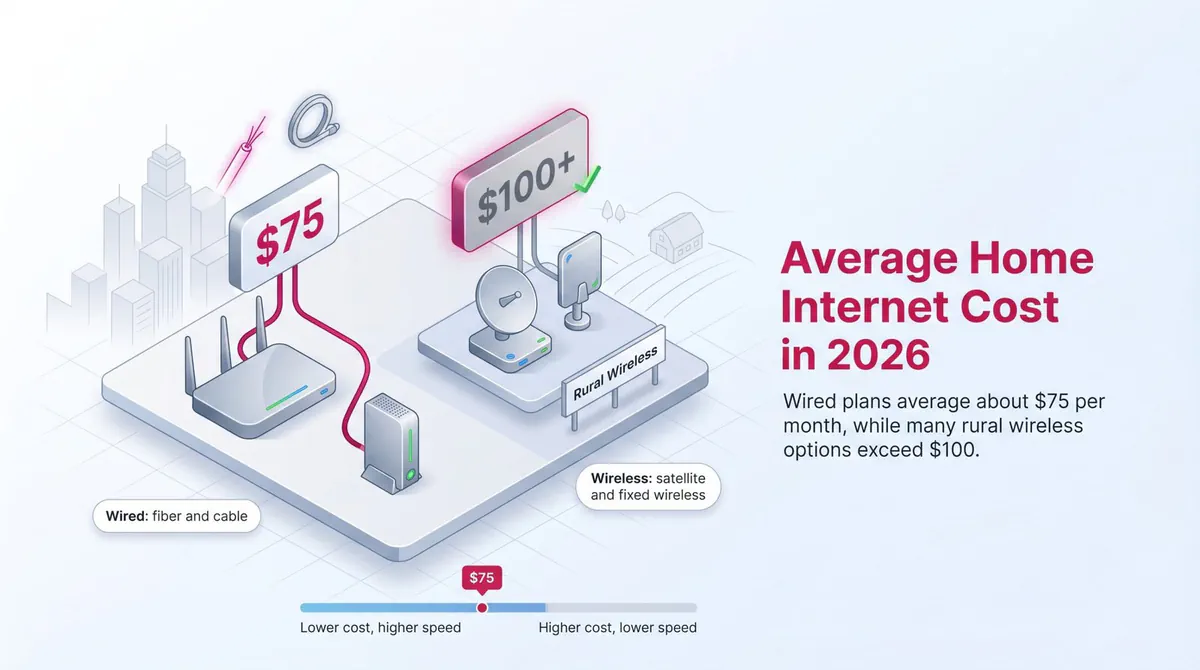
The national average for a wired broadband plan sits near $75 a month, but rural wireless options can push past $100 — the gap that drives most upgrade decisions.
Fiber: the value leader where it's lit
Fiber plans dominate the cheap-per-Mbps rankings in 2026. Frontier's 500 Mbps symmetric fiber runs $54.99, Metronet's 500 Mbps fiber is $59.95, Brightspeed's 500 Mbps fiber is $59, and Google Fiber's gigabit is a flat $70 with no equipment fee. The headline isn't raw speed — it's that upload matches download. If you video-conference from home, push large files to the cloud, or game competitively, that symmetry is the actual reason to pick fiber over cable at the same price.
When fiber is the right call
Two or more people work or learn from home and need solid upload speeds
You want gigabit today and headroom for 2–5 Gbps tomorrow without rewiring
You're paying equipment rental on cable and can switch to a plan that includes the gateway free
Cable: the widely available middle
Cable is the plan you can actually order almost everywhere in the country, and in 2026 the entry tiers are noticeably cheaper than fiber at the same speed. Spectrum's 100 Mbps Internet Advantage starts at $30, Xfinity's NOW Internet 100 is around $30, and WOW!'s 200 Mbps cable is $40 with no contract and no data cap. For a one- or two-person household that streams in HD and runs a standard video meeting or two, cable at 200–500 Mbps is plenty and is usually the lowest-friction choice when you move in.
5G home internet: the no-wait option
5G home internet from T-Mobile, Verizon, AT&T Internet Air, and Starry is the simplest way to get online the day you get your keys. T-Mobile's Rely plan is $50 flat, Verizon's 5G Home is $50, and Verizon's 5G Home Plus is $60. There's typically no installer, no annual contract, no data cap, and no separate equipment fee — the gateway ships to you and you plug it in near a window. The trade-off is that speeds swing: T-Mobile advertises 133–415 Mbps, and real-world results depend on tower distance, window orientation, and neighborhood congestion.
Where 5G home internet makes sense
You're between addresses for a few weeks and need internet tomorrow
Your new place is wired for cable or fiber but the install appointment is 10-plus days out
You split time between two locations and want a plan you can cancel without a fee
DSL: the budget fallback
DSL is the slowest of the four but is still the only wired option in a lot of rural ZIP codes. AT&T's Internet 100 DSL is $60, CenturyLink's Simply Unlimited Internet runs in the $40–$50 range, and Brightspeed and Consolidated still sell DSL in areas where they haven't finished fiber builds. Expect 10–100 Mbps download and single-digit upload, with speed dropping the farther you live from the provider's roadside equipment. It works fine for email, HD streaming on one TV, and light browsing — it does not work fine for a four-person household running multiple 4K streams.
Match speed to household size before you upgrade
A quick sizing rule
1 person, email plus HD streaming: 50–100 Mbps is enough — pick the cheapest plan that hits it
2–3 people, mixed 4K streaming and video calls: 200–300 Mbps is the practical floor
4 or more people, work-from-home plus gaming plus 4K: 500 Mbps–1 Gig avoids peak-hour buffering
Power users, large cloud backups, content creators: 1–2 Gig symmetric fiber is the only category that keeps up
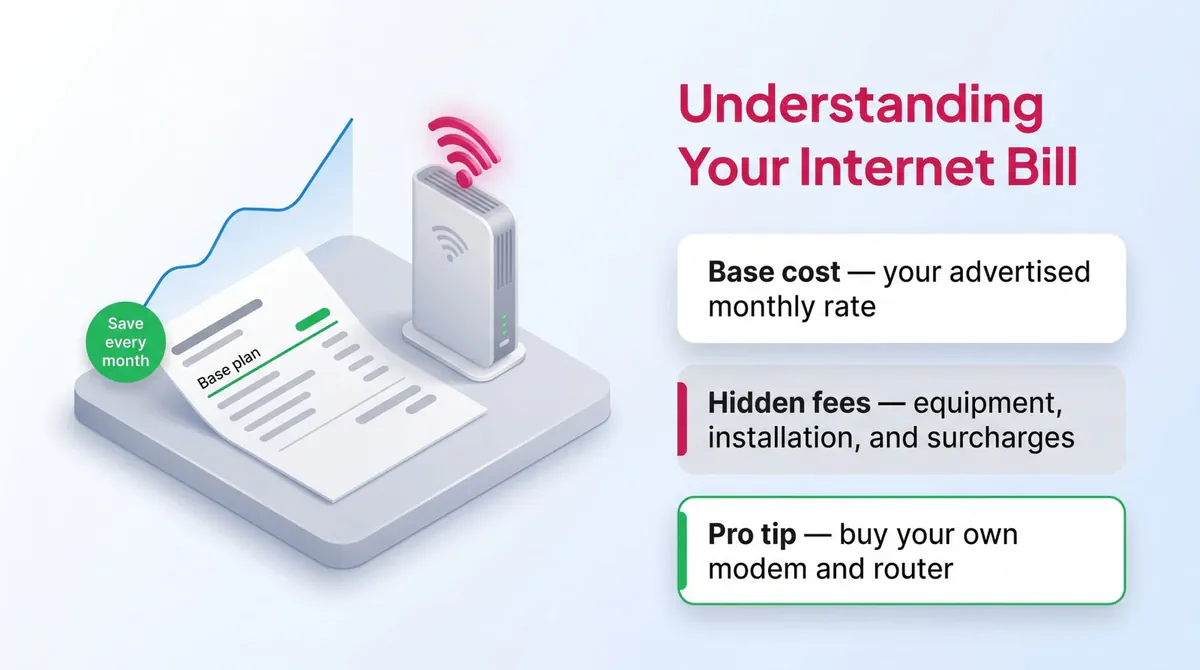
Most advertised prices are base rates. The monthly bill usually grows once equipment rentals, WiFi fees, and post-promotional price hikes are added on.
Installation timing and the real monthly bill
Fiber and cable installs usually need a technician and a 3–10 day wait, though some providers ship self-install kits if the line is already live at your new address. 5G home internet and most cable self-installs skip the truck roll entirely — the gateway shows up in two or three days. Once service is on, the advertised base rate is rarely the final bill: equipment rental runs $5–$15 a month, professional install is $100–$200 (or $300–$500 for satellite), and most promotional prices jump after 12–24 months. Buying your own compatible modem and router typically pays back in under a year.
SUMMARY
The bottom line
Pick the technology that's actually at your new address first; everything else is a tiebreaker. If fiber is available, a 500 Mbps–1 Gig symmetric plan at $55–$75 is the cheapest per Mbps and the most future-proof. If only cable reaches you, a no-contract 300–500 Mbps plan from a provider like Spectrum, Xfinity, or WOW! handles almost every household for $40–$60. If you need service today and can wait for a wired install later, 5G home internet at $50–$70 gets you online in minutes. If DSL is all that reaches the house, plan to live with 50–100 Mbps and budget for a 5G or satellite backup if anyone in the house works or learns from home.
Common questions
Before you move on
Is 5G home internet cheaper than cable?+
Usually, yes for the entry tier. T-Mobile and Verizon 5G plans run $35–$60 with no separate equipment fee, no contract, and no install. Cable starts near $30 but typically adds $10–$15 for a gateway and may require a 12-month term to get the lowest price. Over 12 months, 5G often wins on total cost for a single user; cable wins once a household needs consistent 500 Mbps or higher.
How much should I pay for 500 Mbps?+
In 2026, $50–$65 is a fair price for a 500 Mbps fiber plan with symmetric uploads, and $40–$55 is typical for a 500 Mbps cable plan. Anything above $80 for that speed, after the first-year promo expires, is a signal to call and renegotiate or switch.
Do I need a contract for fiber?+
Most fiber providers in 2026 — Frontier, Google Fiber, AT&T Fiber, Metronet, Brightspeed, and Breezeline Fiber among them — sell no-contract plans at the same advertised price as their term plans. Cable is more mixed: Spectrum is no-contract, while Xfinity and some regional cable ISPs discount the rate in exchange for a 12- or 24-month commitment.