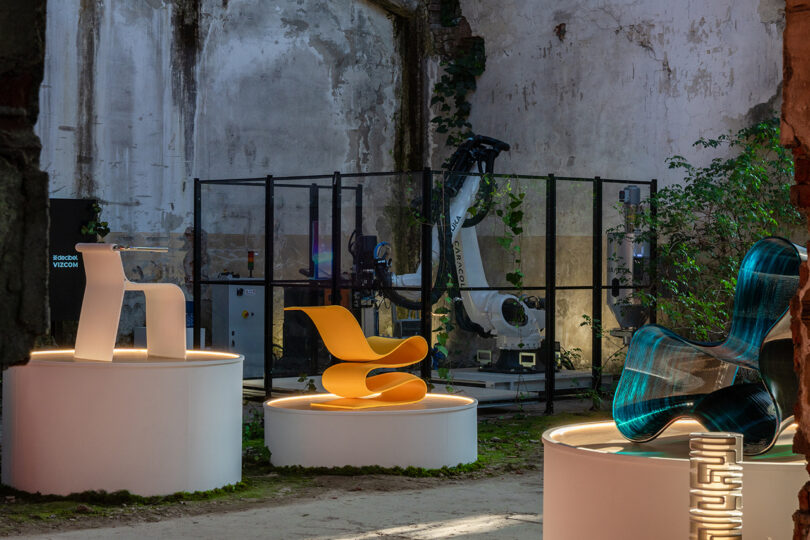
Inside the crumbling concrete shell of the former SNIA viscose factory in Varedo—a site where industrial history breathes through rusted rafters—something radically futuristic has taken root. During the recent Milan Design Week, the PORTAL exhibit, a collaborative powerhouse between Decibel, Vizcom, and Caracol, served as a visceral manifesto for the future of furniture.
The exhibit is a showcase of ten unique chairs, each conceptualized by world-renowned designers and brought to life through Large Format Additive Manufacturing (LFAM). Unlike traditional manufacturing, these pieces were printed in situ using a 15-foot robotic arm, utilizing 100% recycled industrial waste streams. It represents a pivot point in home design: the moment where the high-art of the gallery meets the zero-waste pragmatism of the circular economy. For the modern homeowner or renter, this isn't just about "recycled plastic"; it is about a decentralized manufacturing model that eliminates the massive carbon footprint of transoceanic shipping and material surplus.
The Circular Philosophy: Decibel’s Four Pillars
Decibel’s mission transcends the creation of beautiful objects; it is about building an ecosystem. At the heart of PORTAL is a circular design philosophy anchored by four distinct pillars that work in a continuous loop:
- The Designers: Visionaries who drive market demand by proving that sustainable materials do not require aesthetic compromise.
- The Production Partners: Specialized teams like Caracol who provide the robotic infrastructure and engineering expertise to execute complex geometries.
- The Material Engineers: Scientists who transform industrial waste—from discarded glass fibers to post-consumer plastics—into high-performance pellets suitable for 3D printing.
- The Commercial Customers: Scaling the impact by integrating these pieces into residential and commercial spaces, thereby closing the loop.
The efficiency of this model is staggering. Each chair in the PORTAL exhibition was produced through a continuous 24-hour robotic 3D printing cycle. By utilizing on-site printing, the project demonstrates a zero-waste model where every gram of material is accounted for, and unused pellets can be re-fed into the system for the next print.
The Technology Behind the Art: Large Format Additive Manufacturing (LFAM)
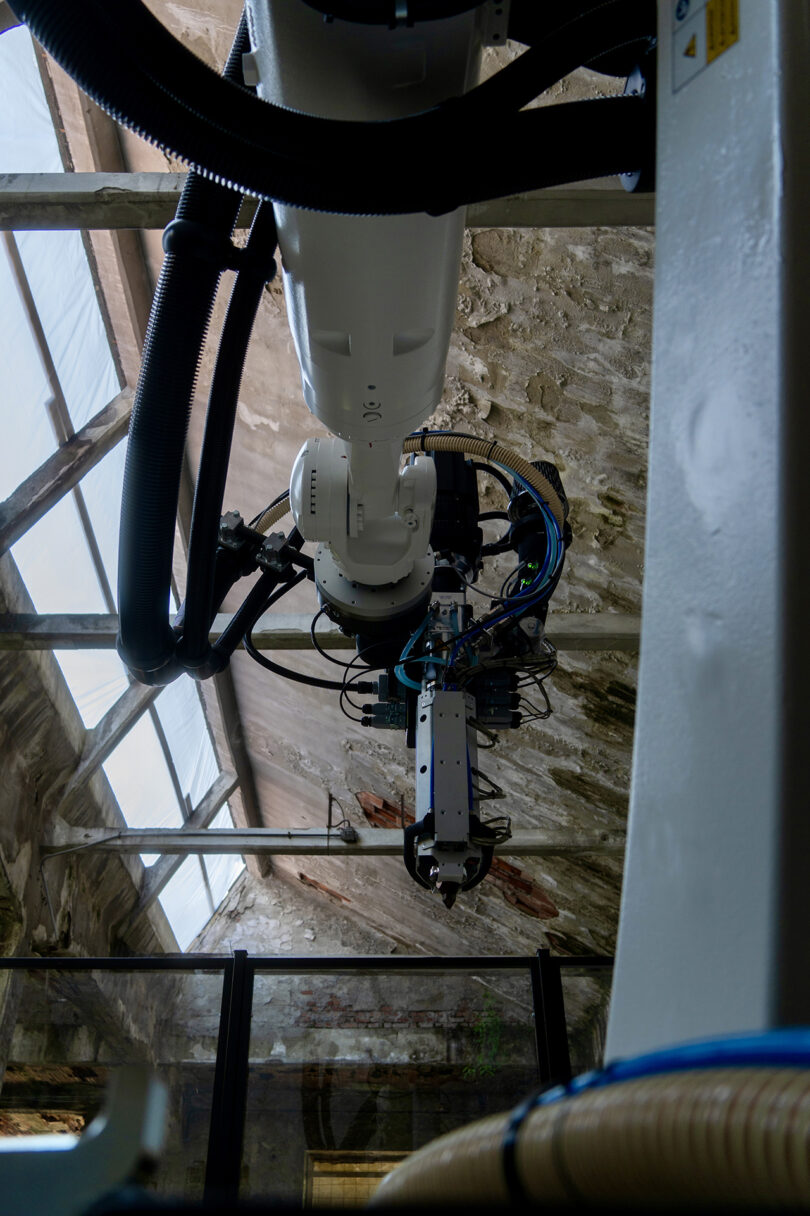
To understand the "why" behind these chairs, one must understand the "how." The exhibit featured the Heron AM robotic platform, a colossal 15-foot arm that moves with a grace that belies its industrial power. This isn't your desktop 3D printer; this is a system capable of extruding high-strength polymers reinforced with recycled glass fiber (rPETG-GF).
The process began in the digital ether. Designers used Vizcom, an AI-assisted tool that allows creators to transform loose sketches into photorealistic, technically viable 3D forms in seconds. This accelerated design phase means that custom, ergonomic furniture can go from a designer’s mind to a finished product in a fraction of the time required by traditional molding or wood-carving methods.
The materials chosen for PORTAL—ranging from rPETG-GF (Glass Fiber) for structural rigidity to TPU for flexible, soft-touch surfaces—are inherently low-VOC and non-toxic. For those of us focused on healthy home environments, the absence of toxic glues and formaldehydes commonly found in mass-produced particle-board furniture is a significant victory for indoor air quality.
Gallery: 10 Visionary Recycled Chairs
The following ten chairs represent the pinnacle of what is possible when robotic precision meets a sustainable conscience.
1. MONARK Chair by Karim Rashid
Karim Rashid, the master of "sensual minimalism," brings his signature fluid geometry to the PORTAL collection. The MONARK chair is a seamless, undulating form that appears to grow out of the ground. The use of carbon-fiber-reinforced recycled PET-G gives it a metallic sheen and incredible structural integrity despite its airy silhouette.
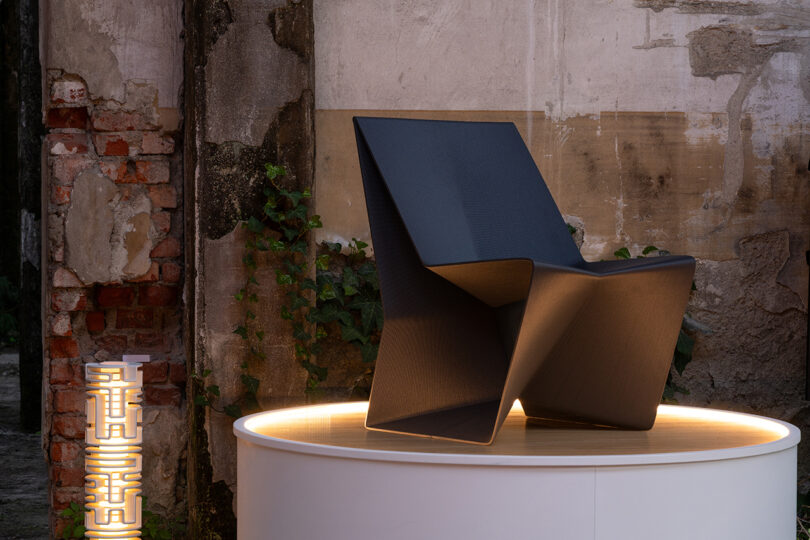
Technical Fact Sheet: MONARK
- Designer: Karim Rashid
- Material: rPET-G + 30% GF (Recycled Glass Fiber)
- Print Time: 7 Hours
- Weight: 23 kg
2. SPROUT Chair by noknok
The SPROUT chair is a masterclass in organic growth forms. Its vibrant yellow hue challenges the misconception that recycled furniture must be drab or earthy. Designed using "stacked modules," the SPROUT chair feels like an organism frozen in a state of upward expansion.
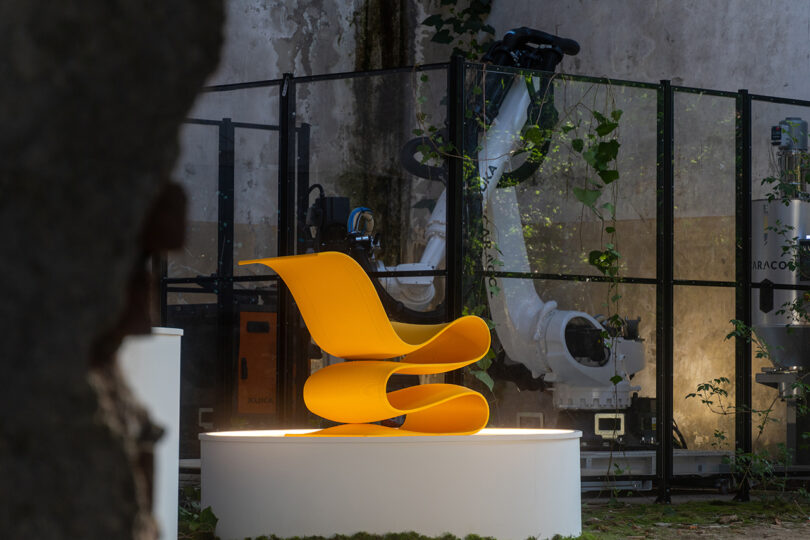
Technical Fact Sheet: SPROUT
- Designer: noknok
- Material: rPET-G
- Print Time: 6 Hours
- Weight: 23 kg
3. CRYSTAL Chair by Deniz Aktay
Deniz Aktay is known for his architectural approach to furniture. The CRYSTAL chair utilizes the transparency of recycled PET-G to play with light and shadow. Its sharp, interlocking lines suggest a complexity that would be nearly impossible to achieve through traditional injection molding.
Technical Fact Sheet: CRYSTAL
- Designer: Deniz Aktay
- Material: Clear rPET-G
- Print Time: 6.5 Hours
- Weight: 20 kg
4. CONTOUR Collection by Charles Birshaw
Birshaw’s contribution focuses on material optimization. The CONTOUR chair is "hollowed out" where weight isn't needed, resulting in one of the most material-efficient designs in the exhibit. It embodies the concept of "doing more with less."
Technical Fact Sheet: CONTOUR
- Designer: Charles Birshaw
- Material: rPET-G + GF
- Print Time: 4 Hours
- Weight: 18 kg
5. LOU Rocker by Brett Akop
The LOU Rocker explores the use of bio-based PLA (Polylactic Acid) in a furniture context. This rocking chair combines the nostalgia of a classic form with the precision of robotic toolpaths. The result is a tactile, ribbed surface that provides a built-in grip and a unique sensory experience.
Technical Fact Sheet: LOU Rocker
- Designer: Brett Akop
- Material: Bio-based PLA
- Print Time: 10 Hours
- Weight: 10 kg
6. BOUNCE Chair by Philippe Bietenholz
Focusing on the "spring" of 3D-printed filaments, the BOUNCE chair uses a cantilevered design to provide natural suspension. Bietenholz has engineered the print path to allow the material to flex under the weight of the user, providing comfort without the need for traditional upholstery foam (which is notoriously difficult to recycle).
Technical Fact Sheet: BOUNCE
- Designer: Philippe Bietenholz
- Material: rPET-G + GF
- Print Time: 7 Hours
- Weight: 25 kg
7. KAVE Chair by Andrew Schainker
The KAVE chair is an evocative, cave-like organic structure. It utilizes a heavier layer height, making the 3D-printing "grain" a deliberate part of the design aesthetic. It feels solid, protective, and deeply grounded.
Technical Fact Sheet: KAVE
- Designer: Andrew Schainker
- Material: Bio-based PLA
- Print Time: 8 Hours
- Weight: 12 kg
8. CLOUD Chair by Willo
The CLOUD chair by Willo is perhaps the most ethereal piece in the collection. By utilizing clear rPET-G reinforced with microscopic glass fibers, the chair catches the light in a way that makes it appear almost weightless, like a frozen vapor.
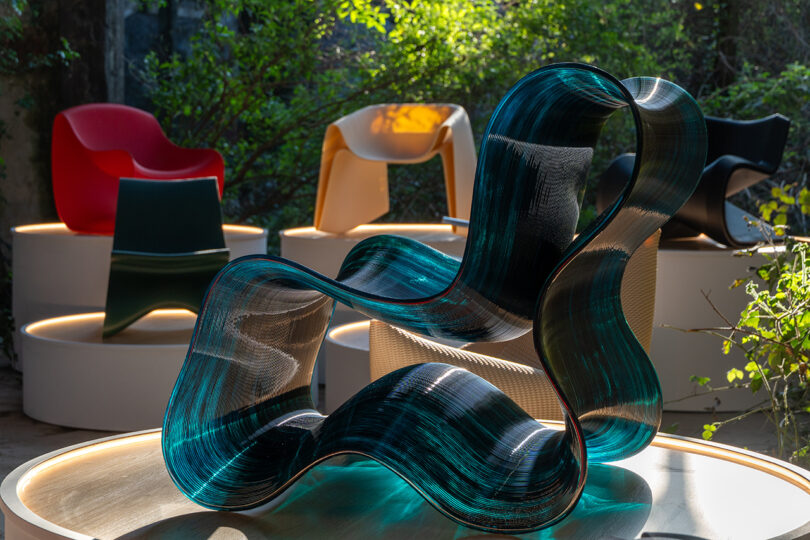
Technical Fact Sheet: CLOUD
- Designer: Willo
- Material: Clear rPET-G + GF
- Print Time: 5 Hours
- Weight: 15 kg
9. COCOON Chair by Willo
In a departure from the rigid PET-G, the COCOON chair uses TPU—a flexible, rubber-like material. The chair is printed as a flat or semi-flat form and then "folded" into its final shape, utilizing a unique post-processing technique that showcases the versatility of the robotic arm.
Technical Fact Sheet: COCOON
- Designer: Willo
- Material: Recycled TPU
- Print Time: 20 Hours
- Weight: 18 kg
10. The Mystery 10th Design: Collaborative Innovation
The final piece in the exhibit was often the one being printed live during the show. This design evolved as the week progressed, incorporating feedback from the visitors and real-time adjustments by the Caracol engineering team. It served as a reminder that 3D printing is a "living" manufacturing process.
Why Recycled 3D Printing is the Future of Furniture
As an editor focused on sustainable living, I see the PORTAL exhibit as more than a gallery of high-end chairs. It is a roadmap for how we will furnish our homes in the next decade.
1. Zero-Waste and Localized Production Traditional furniture manufacturing involves shipping raw materials to a factory, producing a product (with up to 30% material waste), and then shipping the bulky final product across the globe. Decibel’s model suggests a future of "micro-factories." Imagine a robotic arm in your city that prints your furniture using local plastic waste. This eliminates shipping emissions and material surplus entirely.
2. Extreme Customization Because there are no molds, every chair can be unique. A chair can be "resized" digitally to fit a specific person’s height or a specific corner of a room before the "print" button is ever pressed. This democratizes bespoke design.
3. Non-Toxic, Circular Materials By using mono-materials (chairs made of one type of plastic), these pieces are 100% recyclable at the end of their life. If you grow tired of your chair in ten years, it can be ground back into pellets and reprinted into a new design. This is the definition of a "closed loop."
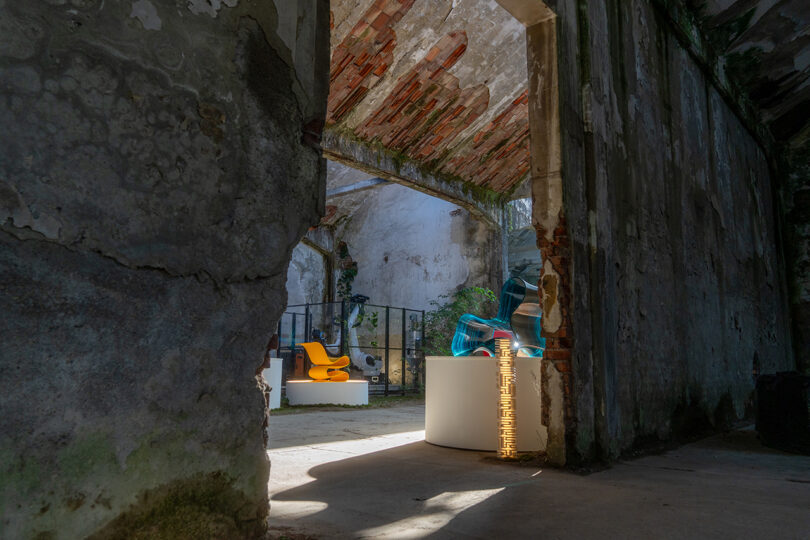
The PORTAL exhibit at the Alcova site was a bridge between the industrial past and a sustainable future. It proved that "recycled" doesn't have to mean "compromised." In the hands of designers like Karim Rashid and the robotic precision of Caracol, waste becomes a luxury material.
FAQ
Q: Are these chairs actually comfortable without cushions? A: Surprisingly, yes. Many designers, such as Philippe Bietenholz, use the specific "flex" of 3D-printed polymers and ergonomic "ribbing" to create built-in suspension. Furthermore, the accuracy of LFAM allows for complex ergonomic curves that match the human body more closely than flat-packed furniture.
Q: Can these chairs be used outdoors? A: Most of the PORTAL collection is made from rPETG-GF or PLA. rPETG is exceptionally UV-resistant and weather-hardy, making it an ideal material for high-end, sustainable outdoor furniture.
Q: How do I recycle a 3D-printed chair if I no longer want it? A: Because these chairs are made from "mono-materials" (a single type of plastic), they are much easier to recycle than traditional chairs made of wood, metal, foam, and fabric. They can be ground down into pellets and used again in Large Format Additive Manufacturing systems.