We have all been there: the "laundry-bin rock bottom." It usually happens on a Sunday evening, midway through hauling a week’s worth of damp towels to the machine. You hear a sharp crack, feel the cheap plastic handle give way, and suddenly, your clean-ish clothes are scattered across the floor. Most of us treat laundry bins as disposable commodities—perforated plastic eyesores destined for a landfill within three years. But if you are tired of the cycle of breakage and the visual clutter of "dorm-room" aesthetics, there is a professional-grade alternative that has been hiding in plain sight for over a century.
Steele Canvas trucks are fundamentally superior to plastic bins because they aren't built for a season; they are built for a lifetime. Constructed with industrial-grade steel frames and high-quality canvas or Steeletex liners, these trucks offer a lifespan that can easily exceed 50 years. While a plastic basket is a $15 purchase you’ll make five times a decade, the Steele Canvas Elevated Truck is a one-time investment in household infrastructure. For apartment dwellers, its secret weapon is a set of agile, smooth-rolling casters designed to navigate narrow corridors and elevators with an "athletic" grace that cheap plastic wheels simply cannot replicate.
The Fragility of Plastic: Why Your Current Bin is Failing You
The standard plastic laundry basket suffers from what I call "Perforated Garbage Can Syndrome." Beyond the obvious aesthetic deficit, plastic is a poor material choice for the heavy, repetitive stress of laundry. Under the weight of three full loads, injection-molded plastic flexes. Over time, heat and UV exposure make it brittle, leading to the inevitable jagged cracks that snag your favorite knit sweaters.
Furthermore, plastic bins are hygiene traps. The static electricity inherent in the material attracts dust bunnies and pet hair, while the narrow ventilation holes are notorious for trapping moisture against the plastic, leading to that distinct "sour" laundry smell if a damp towel sits for more than twelve hours.
| Feature | Mass-Market Plastic Bin | Steele Canvas Elevated Truck |
|---|---|---|
| Frame Material | Injection-molded plastic | Industrial-grade kiln-dried steel |
| Expected Lifespan | 1–3 years (disposable) | 50+ years (heirloom quality) |
| Mobility | Dragging or squeaky plastic wheels | Smooth-gliding industrial casters |
| Capacity | 1.5–2 bushels | 4 bushels (approx. 10 days of laundry) |
| Resale Value | $0 (Landfill bound) | Up to $225 (Vintage market demand) |
Meet the Heavyweight: The Steele Canvas Elevated Truck
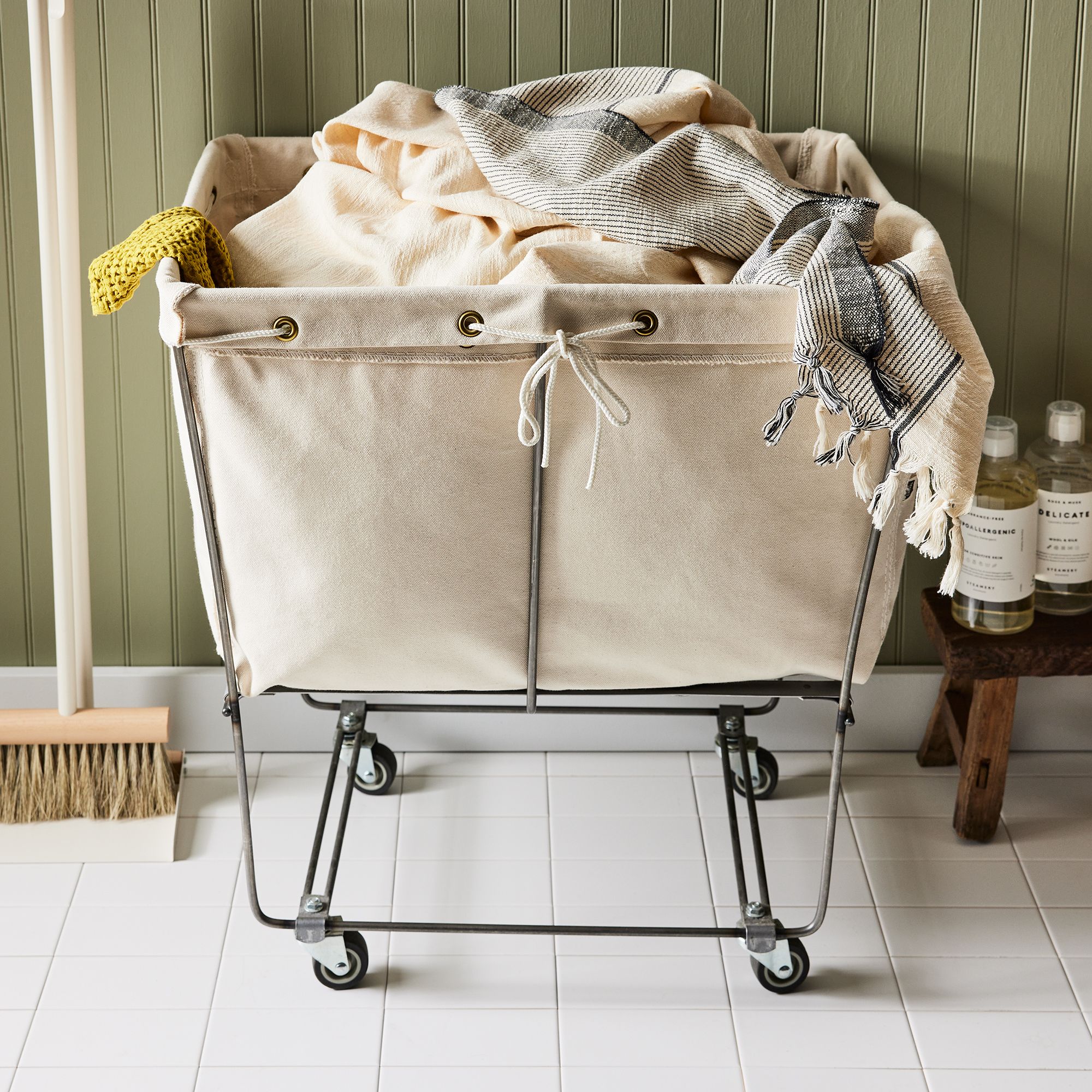
If you want the "Goldilocks" of laundry management, the Steele Canvas Elevated Truck (No. 152) is the industry standard. This isn't a product designed by a marketing team; it was designed for the grueling environments of New England textile mills and hotel laundries. Handcrafted in Chelsea, Massachusetts, since 1921, the No. 152 features a thick steel frame that provides the structural integrity plastic lacks.
The "Elevated" aspect is a game-changer for ergonomics. Standing at approximately 27 inches tall, it brings the top of the basket to hip height. For anyone who has felt that familiar twinge in their lower back after bending over a floor-level plastic bin to sort whites and darks, this elevation is a revelation. It transforms a chore into a streamlined, professional process.
Mobility and 'Athletics': Navigating the Apartment Obstacle Course
The most underrated feature of the Steele Canvas truck is its "athletic" movement. Most rolling plastic bins use cheap, hard-plastic casters that stutter over rug transitions and screech across hardwood floors. Steele uses industrial-grade, non-marking casters that glide.
In a tight urban apartment, this mobility is essential. I’ve found that the 4-bushel truck can be spun 360 degrees on a dime, making it easy to tuck into a closet or navigate through a narrow galley kitchen. It doesn't just roll; it tracks. Whether you are pushing it down a long hallway to an elevator or simply moving it out of the way to vacuum, the stability of the steel base ensures it won't tip over—a common failure of top-heavy plastic carts.
Editor’s Tip: If you live in an apartment with shared laundry facilities, the Steele Canvas truck isn't just a bin; it's a vehicle. It handles the weight of heavy detergents and multiple loads without the "wobble" that makes plastic carts feel like they are about to disintegrate.
Steeletex vs. Standard Liners: The Moisture Battle
A common concern with canvas is how it handles moisture. If your household produces a lot of wet towels or sweaty gym gear, the standard natural canvas might be a concern for mildew. This is where Steele’s industrial heritage shines. They offer a material called Steeletex—a commercial-grade, vinyl-coated nylon used in the commercial fishing industry.
Steeletex is completely waterproof, tear-resistant, and antimicrobial. It provides the same industrial strength as the canvas version but allows you to toss in a soaking wet swimsuit without a second thought. Unlike plastic, which holds moisture in stagnant puddles at the bottom, the construction of the Steele truck allows for better peripheral airflow, which is critical for preventing mold during the "limbo" period before wash day.
The Smart Investment: Capacity and Resale Value
As a product editor, I always look at the long-term ROI (Return on Investment). A Steele Canvas Elevated Truck is optimized for high-volume use. Its 4-bushel capacity is designed to hold approximately 10 days of laundry or three full loads for an individual. This allows you to consolidate your chores, reducing the frequency of trips to the laundry room.
Then there is the "Vintage Factor." While a three-year-old plastic bin is literal trash, a vintage Steele Canvas basket is a collector's item. It is not uncommon to see 50-year-old Steele trucks—bearing a beautiful patina on the steel and weathered canvas—retailing on secondary markets like Etsy or specialized vintage furniture shops for upwards of $225. You are essentially buying a piece of furniture that appreciates in character and retains its value, rather than a disposable plastic shell that loses all value the moment you leave the store.
Customization and Versatility
Beyond its primary function, the Steele truck is a master of versatility. Many users choose to add permanent dividers to their trucks to separate lights and darks at the point of entry, eliminating the need for a secondary sorting process.
The aesthetic is also "trans-stylistic." It looks just as at home in a minimalist industrial loft as it does in a rustic farmhouse mudroom. I’ve seen readers use smaller versions for toy storage in children’s rooms or for holding firewood by the hearth. The tensile strength of the frame means it can handle the weight of heavy linens or even books without the sagging or bowing that plagues plastic storage solutions.
FAQ
Q: Is the 4-bushel size too large for a small studio apartment? A: Surprisingly, no. Because the Elevated Truck is vertical and mobile, it often takes up less usable "space" than two or three cluttered plastic baskets. Its footprint is sleek, and because it rolls so easily, it can be stored in a closet and brought out only when needed.
Q: How do I clean the canvas liner? A: For standard canvas, a simple spot clean with mild detergent and a brush usually does the trick. If you choose the Steeletex liner, you can simply wipe it down with a disinfecting wipe or a damp cloth, making it the lowest-maintenance option for busy households.
Q: Are the casters safe for high-end hardwood floors? A: Yes. Steele uses non-marking, high-quality casters. Unlike the sharp edges found on some molded plastic wheels, these are designed for industrial floors and won't scratch or leave streaks on your home’s surfaces.
Final Thought
If you are ready to stop treating your laundry routine as a series of equipment failures, it’s time to look toward the industrial sector. The Steele Canvas Elevated Truck is the last laundry bin you will ever buy—a rare claim in a world of planned obsolescence. It’s an upgrade that pays for itself in durability, back health, and the simple, quiet joy of using a tool that actually works.