How do I fill out a moving company damage claim form for a household goods shipment and what federal law governs my recovery?
To recover for broken, damaged, or missing items, you must submit a written claim that lists every affected piece, attaches photos and receipts, and requests a specific dollar amount. Federal law (the Carmack Amendment) sets the ground rules—from the nine-month filing window to how your chosen valuation coverage caps what the carrier owes.
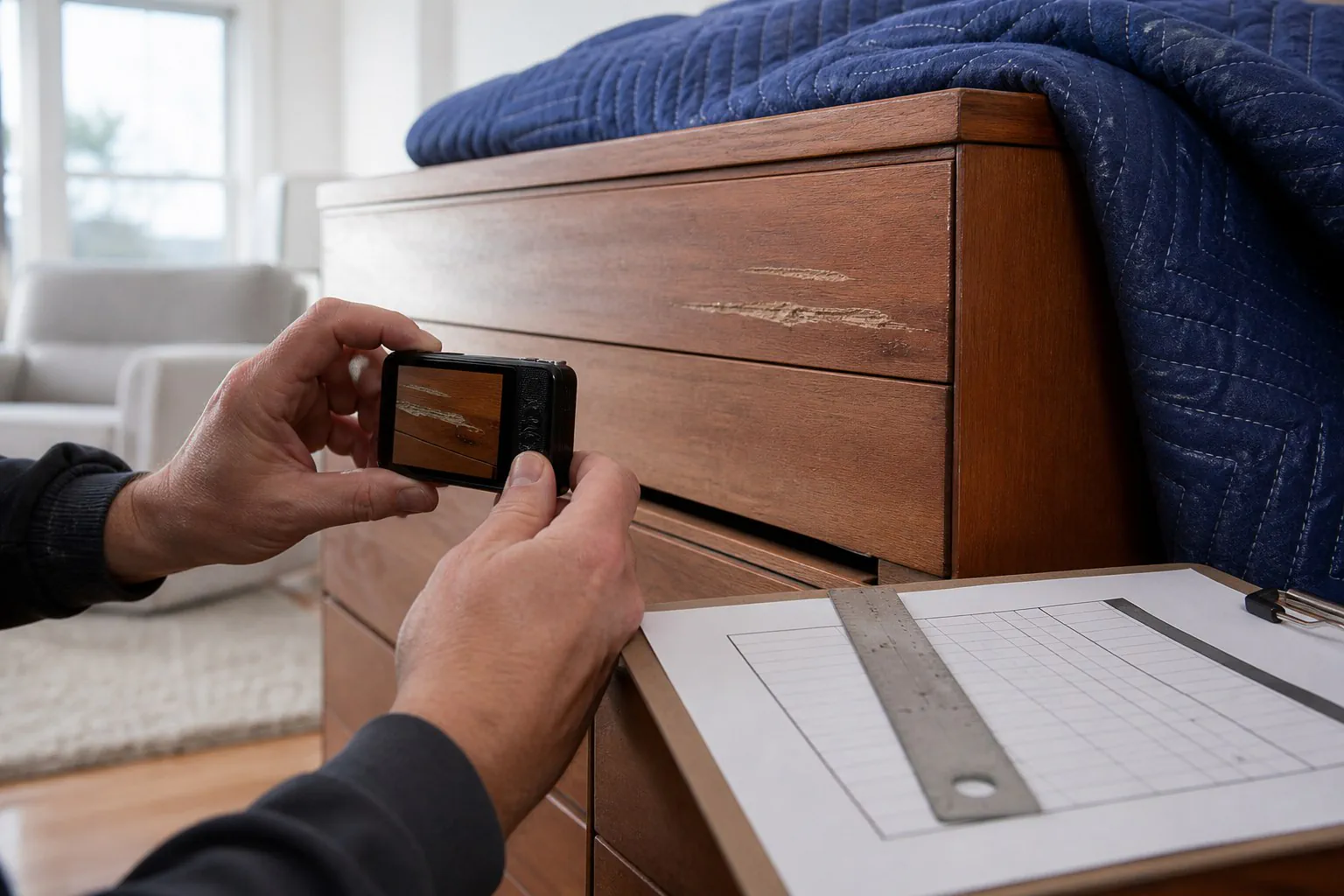
Your recovery is governed by the federal Carmack Amendment when you move household goods across state lines. Fill out the damage claim form by using your Bill of Lading to enter shipment details, identifying each item by its inventory tag number, describing the damage precisely, and stating the exact dollar amount you seek. Attach before-and-after photos, repair estimates, and original purchase receipts. Your payout ceiling depends on the valuation coverage you selected before the truck left.
The federal law behind your right to be paid
Interstate household-goods carriers are liable under the Carmack Amendment, a federal statute that holds them responsible for “actual loss or injury” to your property while it moves across state lines. The law guarantees you at least nine months from the delivery date to file a written claim, and it requires the carrier to acknowledge receipt within 30 days and to pay, deny, or make a firm settlement offer within 120 days. How much you ultimately recover, however, turns almost entirely on the damage you documented at delivery and the valuation option you selected before the shipment left your old home.
What you need before you touch the claim form
The claim form asks for information that lives in just a few documents you already have. Pull them together before you start writing so you don’t have to hunt for details later.
Gather these documents and details
- Bill of Lading
The master contract that contains your shipment number, pickup and delivery dates, the declared valuation of your shipment, and the inventory tag numbers assigned at origin.
- Annotated delivery inventory
The list the crew updated as they unloaded. Every scratch, dent, crushed box, or missing item you noted on the spot is your strongest evidence.
- Damage photos
Clear images of each damaged item, the packaging it arrived in, and any inventory stickers still attached. Pair them with pre-move photos showing the same item in good condition.
- Original purchase receipts and repair estimates
These support the dollar figure you request. Even a credit card statement or an old email order confirmation is helpful.
How the form connects to your valuation coverage
Before the move began, you chose between two valuation options. The one printed on your Bill of Lading dictates the maximum the carrier can owe you, and the gap between what you paid for an item and what the carrier pays out often surprises people.
Released Value vs. Full Value Protection
| Released Value | Full Value Protection |
|---|---|
| The default, no-cost option. Carrier liability is capped at 60 cents per pound per item. A 25-pound television that cost $800 would yield $15. | You pay extra for the carrier to assume responsibility for the replacement value of lost or damaged goods. The carrier may repair the item, replace it with a similar one, or pay current market value. |
| Suitable only for items of low monetary or sentimental value. Most who pick this option underestimate how little it pays. | Often includes a deductible, and items of “extraordinary value” (worth over $100 per pound) must have been listed on a high-value inventory form before the move to remain fully covered. |
Filling out and submitting the claim
How to complete the damage claim form
- Identify each item by its inventory number
Use the tag numbers the movers assigned at pickup. For every damaged or missing piece, describe the condition in plain, specific language—“dining table leg snapped off,” not just “broken.” This helps the adjuster understand what happened without requesting more detail and slowing the review.
- State your requested dollar amount for every line
A valid federal claim must specify a definite sum. “About $500” will not satisfy the requirement. List the original purchase price and the amount you are claiming; the gap between them should reflect your valuation coverage.
- Attach all supporting evidence
Include before-and-after photos, repair estimates, and receipts for the original purchase price. The carrier’s adjuster will lean heavily on these when determining your offer.
- Send the packet with proof of delivery
Certified mail with a return receipt creates an indisputable timeline. If you file online through the carrier’s portal, save the confirmation number, screenshot the submission page, and follow up with an email to the claims department restating the date you submitted your claim.
- Keep a full physical or digital copy
Store the completed form, every photo, every receipt, and every repair estimate in one place. If the carrier later says a document was never received, you can resend it immediately and avoid missing the nine-month deadline while you wait for clarification.
What happens after the carrier gets your claim
Federal regulations force the carrier to stay on a clock. Within 30 days it must acknowledge your claim in writing and let you know if it needs more documentation. From that receipt date it has 120 days to pay, deny, or make a firm settlement offer. If the investigation takes longer, the carrier must send a written status update every 60 days until the matter is resolved.
The lawsuit clock starts at the denial, not at delivery
If the carrier denies your claim, federal law gives you at least two years from the date you receive the written denial to file a lawsuit. This two-year clock does not start on delivery day; it begins only when the carrier officially disallows part or all of your claim.
SUMMARY
The bottom line
Every dollar you recover begins with the notes you make at the delivery tailgate. Mark damage on the inventory in real time, photograph everything, and file your formal claim as soon as possible. Your payout cap was locked in the moment you chose Released Value or Full Value Protection, and no amount of paperwork can raise it after the fact. By checking your Bill of Lading before you file, you can set realistic expectations and avoid surprises when the settlement letter arrives.
Common questions
Before you move on
I didn’t write anything on the delivery inventory. Can I still file a claim?+
Yes. Skipping the delivery-day notation does not erase your right to file, but it makes the process harder because the carrier will argue the damage happened after the crew left. If you discover hidden damage later, file immediately and include detailed photos of the item and its packaging.
What if I chose Released Value—do I really only get 60 cents per pound?+
Yes. That figure is not a typo. For a 25-pound television that originally cost $800, the carrier would owe $15. Released Value is the default free option, and many people don’t realize how little it pays until they file a claim.
Can I upgrade my coverage after I see the damage?+
No. The valuation option you selected is printed on your Bill of Lading and cannot be changed once the shipment is on the truck.
How long does the carrier have to respond to my claim?+
Federal regulations require the carrier to acknowledge your claim within 30 days of receipt and to pay, deny, or make a firm settlement offer within 120 days. If it needs more time, it must send you a written status update every 60 days until the claim is resolved.