What documentation do I need to support a mover damage claim under federal regulations and what timelines apply?
For an interstate household-goods move, 49 CFR Part 370 sets the documentation and the clock. Here is what to capture at delivery, what to send the carrier, and the deadlines that bind both sides.
Federal rules at 49 CFR Part 370 govern damage claims on interstate household-goods moves. A consumer has nine months from delivery to file a written claim; the carrier has 30 days to acknowledge it and 120 days to pay, deny, or make a firm written settlement offer. The evidence that wins or loses a claim is built at delivery: condition notations on the inventory sheet, damage exceptions on the delivery receipt, and a structured set of timestamped photographs. These timelines and standards apply to interstate moves only; purely in-state moves are governed by state regulators and the contract you signed, not by 49 CFR Part 370.
The federal damage-claims framework for household-goods carriers lives at 49 CFR Part 370. It binds both the consumer and the mover to a specific sequence: file a written claim within nine months of delivery, receive written acknowledgment within 30 days, and reach a resolution — payment, denial, or a firm written settlement offer — within 120 days. These are enforceable federal deadlines, not industry courtesies. A carrier that ignores them has violated the regulation, which is the basis for a parallel FMCSA complaint.
When federal rules apply — and when they do not
49 CFR Part 370 covers interstate household-goods shipments — moves that cross a state line. If your move started and ended in the same state and you hired an in-state carrier, the federal framework almost certainly does not apply. Your rights are set by your state public utility commission (or equivalent state regulator) and the contract you signed. State filing windows are often shorter than nine months, the documentation standards vary, and the FMCSA complaint process is not available because the shipment was never in federal jurisdiction. Confirm which regulator covers your move before assuming the federal deadlines protect you.
Service members on a military move are in a different system altogether. Personal property claims go through the Defense Personal Property System (DPS) and the Military Claims Office (MCO), with its own notice, filing, and settlement windows. The rest of this article addresses the civilian interstate framework under 49 CFR Part 370.
The two baseline documents
Two pieces of paperwork control the claims process: the Household Goods Descriptive Inventory produced at pickup, and the delivery receipt you sign at destination. The first is the "before" record of every item loaded, with condition notations using industry abbreviations (S scratched, D dented, BR broken, M marred, CH chipped, SO soiled, RU rusted). The second is the "after" record, with a remarks or exceptions field where delivery-day damage is written before signature. If a piece of furniture arrives with damage that has no matching notation at pickup, the working presumption is that the damage occurred in transit — and that is the carrier's liability. If the notation is already on the inventory, the carrier can argue the damage predated the move.
What to write on the delivery receipt before signing
Each damaged item, described specifically (e.g., "three-inch crack across tabletop," not "damage to table").
Each missing item, written as "not delivered" or "short" with the inventory line reference.
The location of the damage on the item, so the notation is tied to a specific spot.
The crew member's name if the damage was discussed at the door, so the contemporaneous record is anchored.
Photographs that actually hold up
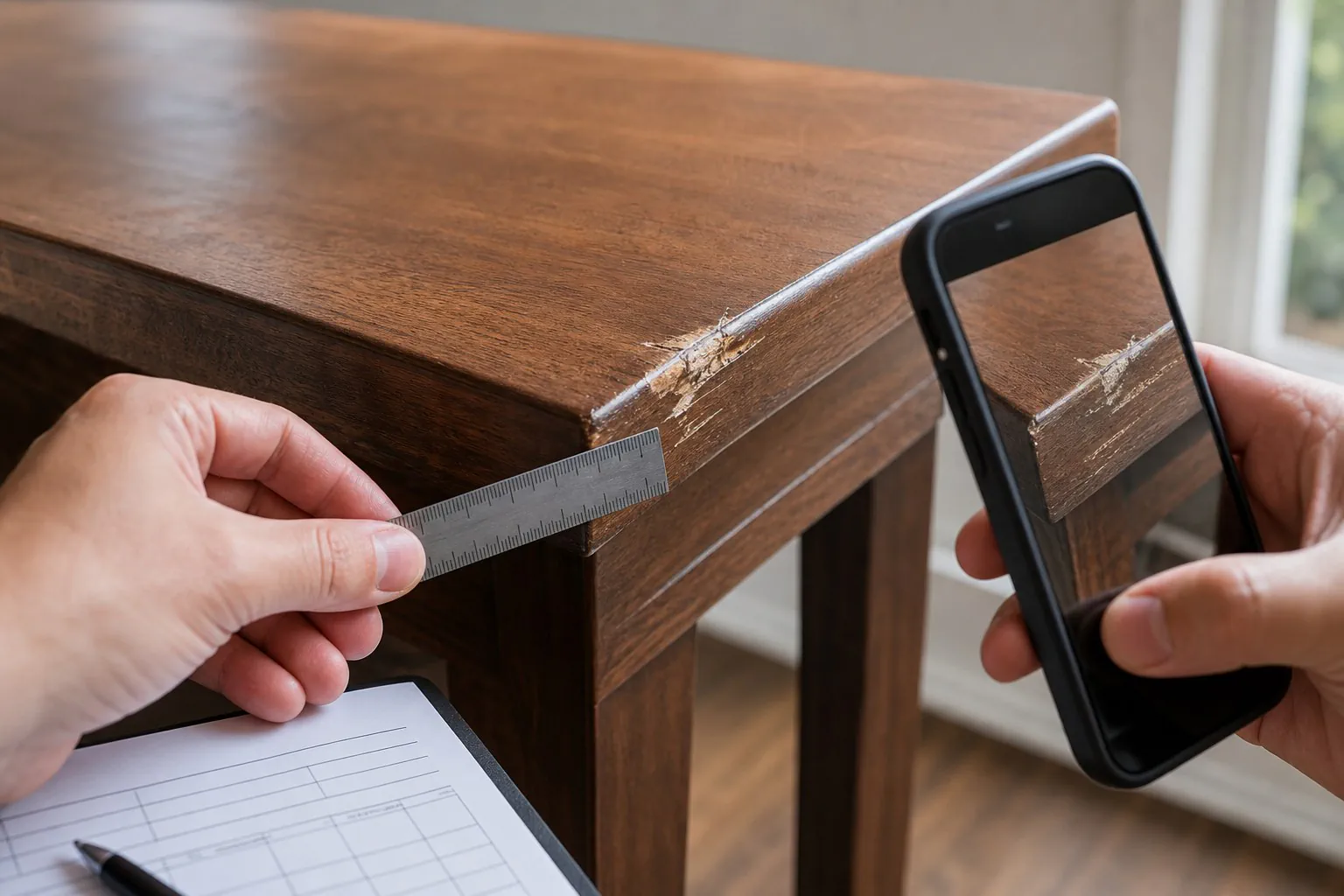
A timestamped photo of a damaged item in the spot the crew placed it is substantially stronger evidence than a photo taken the next morning after you have reorganized the room. Quality and context matter as much as the fact of having them. Keep the original packing materials for at least 30 days after delivery — the carrier or its adjuster may ask to inspect them, and a crushed box that held a cracked vase tells a different story than an undamaged box that did.
Photo sequence for each damaged item
✓
Wide shot
The item in its unloaded position in the room, establishing context and location.
✓
Mid-distance shot
The entire piece with the damage visible in the same frame.
✓
Close-up with scale reference
A coin, a hand, or a ruler in frame to convey the size of the damage.
✓
Functional state for electronics
Powered on if the device still works, or photographed non-functional if it does not.
✓
Packing materials
Exterior and interior of the box, photographed before disposal.
Federal timelines at a glance
49 CFR Part 370 sets a three-stage clock. Filing in the first two weeks after delivery is the strongest move: the evidence is fresh, the carrier is still in the operational frame of the move, and the contemporaneous record is at its most credible. Claims filed late in the nine-month window are still valid, but the evidence picture is harder to assemble and the carrier may read the delay as a sign that the damage was minor.
49 CFR Part 370 deadlines
Delivery date
Damage clock starts; this is the window to note exceptions and capture the photo set.
File the written claim
Strongest evidence picture; sets the carrier's 30-day acknowledgment clock running.
Final filing deadline
Per 49 CFR 370.3. After this, the carrier is no longer required to consider the claim.
Carrier must acknowledge in writing
Per 49 CFR 370.5. Acknowledgment is not agreement to pay.
Carrier must pay, deny, or make a firm written settlement offer
Per 49 CFR 370.9. A vague denial is itself a procedural issue.
Written status updates every 60 days
Required until the claim is resolved.
What the written claim must contain
A claim is a formal document, not a phone call or an email. It is the document that starts the federal clock. Send it to the carrier's official claims department — the address is on your bill of lading or obtainable from the carrier's website — by certified mail with return receipt, which creates proof of delivery and pins down the date the 30-day acknowledgment clock began.
Required contents of a 49 CFR Part 370 claim
Shipment identification: bill of lading number, pickup and delivery dates and addresses, and the carrier's USDOT number.
An itemized list of every damaged or missing item, with the damage described per item rather than as a lump sum.
A dollar amount claimed for each item, supported by a repair estimate or current replacement-cost evidence.
Copies of the pickup inventory sheet with its condition notations and the delivery receipt with its exceptions.
Photographs sorted by item, clearly labeled, taken at or near the time of delivery.
For furniture and specialty items, a repair estimate from a local shop; for electronics, a current retail price listing for the same model.
If the carrier stalls or denies
Missing the 30-day acknowledgment or the 120-day resolution deadline is itself a federal violation, independent of the merits of the claim. A denial must come with specific written reasons under 49 CFR 370.9; a vague denial is procedurally weak and worth challenging. When the formal process stalls, several practical options exist.
Escalation paths after a stalled or denied claim
Re-submit by certified mail if the carrier claims it never received the original, so the clock restarts on a date you can prove.
File an FMCSA complaint, which creates a federal enforcement record and applies pressure independent of the dollar amount in dispute.
For small dollar amounts, small-claims court is a practical option once the federal process has run its course.
For purely in-state moves where 49 CFR Part 370 does not apply, your state attorney general's consumer protection office and your state PUC are the right venues.
SUMMARY
The bottom line
49 CFR Part 370 gives interstate consumers a structured nine-month filing window, a 30-day acknowledgment rule, and a 120-day resolution rule. None of those timelines helps if the damage is not documented at delivery. The single most consequential 30 minutes of the entire move is the inspection period before you sign the delivery receipt — that is when the inventory sheet notations, the delivery-receipt exceptions, and the timestamped photo set are created. After a clean signature, every step becomes reconstruction rather than evidence. In-state moves do not get these federal protections, so the contract and the state PUC's rules are what govern.
Common questions
Before you move on
Can I still file a claim if I signed a clean delivery receipt?+
Yes. A signed clean receipt is not an absolute bar to a claim, but it shifts the burden: contemporaneous damage notations on the receipt are the strongest evidence, and without them you are reconstructing the timeline after the fact. Photos, the inventory sheet, and a written claim submitted promptly can still support a recovery.
Does 49 CFR Part 370 apply to my in-state move?+
Almost certainly not. The federal framework covers interstate household-goods moves. In-state moves are governed by your state public utility commission and the contract you signed; state filing windows are often shorter than nine months, and the FMCSA complaint process is not available because the shipment was not in federal jurisdiction.
What if I have no photos of the damage?+
You can still file. Photos are the strongest single piece of evidence, but the pickup inventory sheet, the delivery-receipt exceptions, repair estimates, and replacement-cost documentation also matter. A claim without photos is harder to prove, especially for items that were not noted as damaged at pickup.
Is a phone call or email to the carrier the same as filing a claim?+
No. Under 49 CFR 370.3, the consumer must file a written claim, and the 30-day acknowledgment and 120-day resolution clocks run from the carrier's receipt of that written document. A phone call or email does not start the federal timeline.