What do real people's full moving experiences look like from the first quote to final delivery?
Two reader-submitted long-distance moves, the questions those movers were asked before, during, and after the truck rolled, and what their answers reveal about hiring a mover with confidence.
Real full moving stories cover four stages: the quote and booking phase, pre-move preparation, moving day itself, and post-delivery follow-up including damage claims. They capture the in-between moments most reviews skip — how many quotes the person got, whether the final cost matched the estimate, what communication looked like in transit, and whether the company followed up after the truck unloaded.
Most moving reviews you read online cover one moment — the bad delivery, the surprise fee, the friendly crew. Full moving stories are different. They start weeks before the truck shows up and end weeks after it leaves, and they document the decisions, communications, and small frictions in between. Two reader-submitted moves documented through the Better Moves Project show what that full arc actually looks like, and what questions you should be asking at each stage to make sure your own story turns out well.
What a full moving story captures
A complete move story is structured around three touchpoints: before the move, on moving day, and after delivery. The people who submit these accounts are asked to share their actual quote screenshots, photos from loading and unloading, and notes on what changed between the estimate they were given and the final invoice. The goal is to make the invisible middle of a move — the parts you only learn about by living through them — visible to the next person planning a move.
Stage 1: the quote and booking phase
Every documented move begins with the question of how the customer found a mover in the first place. In the Better Moves Project submissions, participants report how many websites they checked, how many quotes they requested, and what made them pick one company over another. The answers tend to cluster around three factors: the dollar amount of the quote, how the salesperson handled questions before booking, and whether anyone explained how to prepare for the move.
Questions to capture at the quote stage
✓
Screenshot the quote
Save the actual estimate document or chat, not just the number. The line items matter if there is a dispute later.
✓
Record the quoted weight or cubic footage
If the company gave you a weight estimate, write it down. This is the number that drives most variable-cost moves.
✓
Note how many quotes you compared
Three is a common minimum; some customers compare five or more before choosing.
✓
Save at least one or two messages from the company
Texts or emails that confirm what was promised are useful evidence if the moving day story does not match.
The first survey prompt asks movers to record basics about who is moving, how far, and how much stuff — the same details a salesperson would need to give an accurate quote.
Stage 2: the pre-move window
Between booking and moving day, the documented moves track how the company stayed in touch. Did they call to confirm? Did they walk the customer through preparation? Sally, who moved from Illinois to Massachusetts with Mayzlin Relocation, and Bethany, who moved from California to Virginia with PODS, both documented this stretch. In Sally's case, the company provided preparation guidance before the move. In Bethany's case, the container model meant her pre-move work was more about packing on her own timeline and scheduling the container drop-off and pickup.
This is also the stage where the customer's own preparation happens — purging, packing non-essentials, arranging time off work, planning for kids or pets on moving day. The stories flag this because the cheapest way to lose money on a move is to be unprepared when the crew shows up.
The pre-move survey collects the timeline between deciding to move and actually moving — useful for benchmarking how far ahead most people book.
Stage 3: moving day itself
Moving day is the part most reviews actually cover, but the full-story format asks for specifics that ordinary reviews skip. Did the movers arrive on schedule? How long did loading actually take? Did the final cost match the estimate, or did it change at the door? Were there any specialty items — a car, antiques, a piano — and how were they handled?
What the moving-day survey asks the customer to document
Arrival time versus scheduled time
Quality of communication from the crew lead during the day
Whether the crew handled items carefully in the customer's view
At least eight photos: boxes, the truck, loading, items inside the truck, packing, wrapping
Total time the crew spent loading
Whether the final bill matched the original estimate
Sally's moving-day account captured the Mayzlin crew's arrival window and loading pace; Bethany's captured the PODS container being dropped off, packed at her pace over several days, and then picked up. Different service types produce different moving-day stories, but both formats ask the same question: did what happened match what was promised?
Stage 4: transit and delivery
For long-distance moves, the middle of the story is the transit window — the days or weeks between loading and delivery. The full-story format asks how long the truck took to arrive, whether the customer got updates, and whether delivery happened on the date in the original plan. For interstate moves, federal rules require the carrier to give an estimated delivery window; whether they hit it is one of the most useful signals a documented move can offer.
Bethany's PODS move involved a container shipped across the country and delivered on a scheduled date. Sally's full-service move with Mayzlin involved a truck that arrived within the agreed window. Both reported on the unloading process — how the crew behaved, how long it took, whether anything was damaged — and whether the company followed up afterward to ask how the move had gone.
Stage 5: the final reckoning
The last set of questions asks the customer to step back and judge the whole arc. Did the move go as expected? What do they wish had gone differently? What advice would they give to someone in a similar situation? Would they use the same mover again?
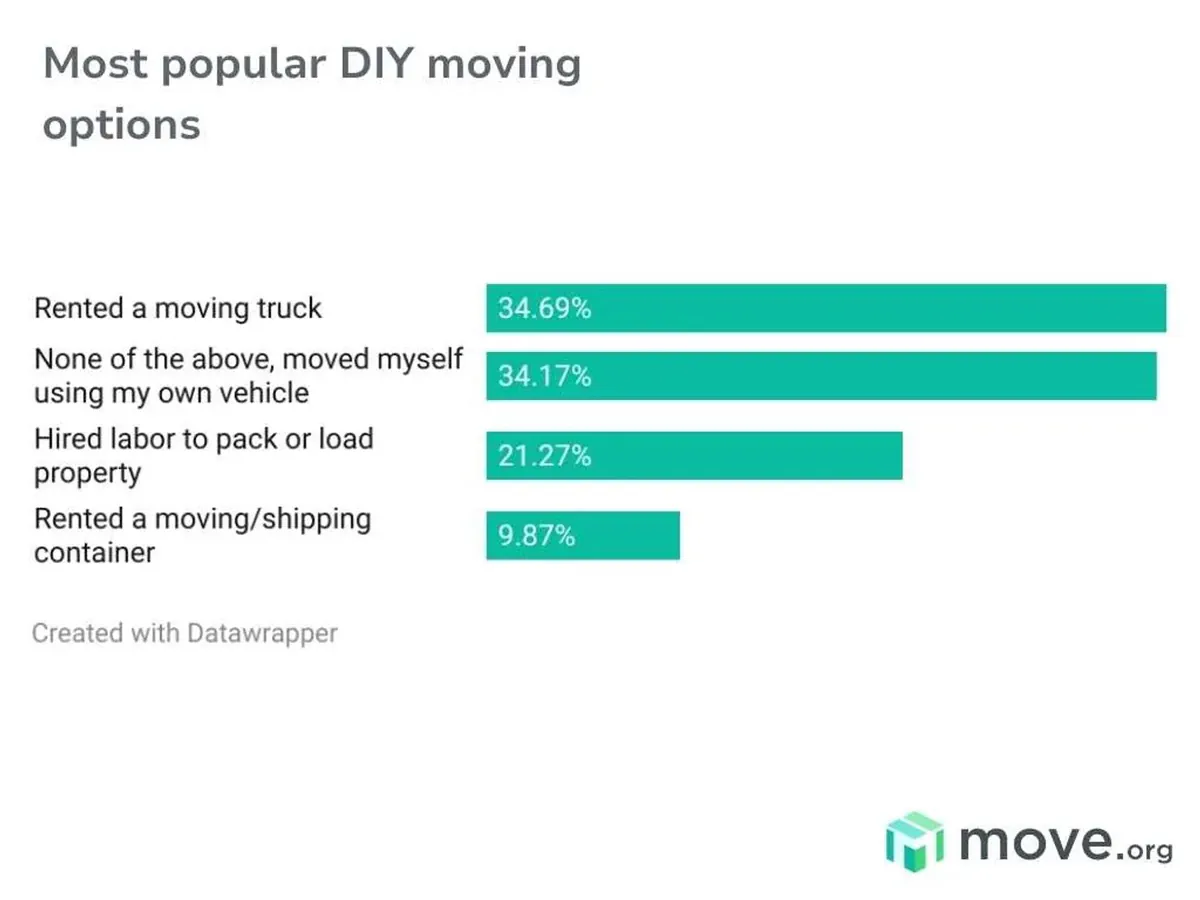
A bar chart from the 2025 Move.org State of Moving report showing the most popular DIY moving options — a useful reminder that the "how people move" question has more than one honest answer.
Two documented moves, side by side
Stage
Sally (IL to MA, Mayzlin)
Bethany (CA to VA, PODS)
Service type
Full-service moving company
Moving container
Quote process
Phone and online estimate; quote saved as screenshot
Online quote based on container size and distance
Pre-move contact
Preparation guidance provided by company
Self-paced packing; container drop-off and pickup scheduled
Moving day
Crew arrived on schedule; loading paced and documented
Container delivered; loaded over several days at her pace
Transit
Truck arrived within agreed window
Container shipped and delivered on scheduled date
Delivery
Crew unloaded; final cost compared to estimate
Container placed at new home; customer unloaded
Post-move follow-up
Company checked in after delivery
Self-managed unpacking; no damage to report
How to use a full moving story when you plan your own move
Build your own four-stage story
01
At the quote stage, save everything
Screenshot the estimate, save emails or texts, and note the quoted weight or volume. The estimate is the single most important document if anything goes sideways later.
02
During pre-move, track the communication
Note how often the company contacts you, whether they explain preparation, and how easy they are to reach when you have questions. Silence here often predicts trouble on moving day.
03
On moving day, photograph and time everything
Take at least eight photos: the truck, the crew working, items being wrapped, items inside the truck. Record arrival time, loading duration, and any cost changes discussed at the door.
04
After delivery, document damage immediately and in writing
Photograph any damage before the crew leaves. Ask, in writing, how the claims process works and what the timeline is. For interstate moves, federal arbitration is available; for in-state moves, check your state's rules.
SUMMARY
The bottom line
A real moving story is not a review — it is a four-stage record: quote, pre-move, moving day, and post-delivery. The most useful information is the kind most online reviews skip: how many quotes were compared, what the estimate said versus what the final bill was, how communication felt in transit, and whether the company followed up after the truck left. Read full moving stories before you hire, and build your own as you go — the document you create today is the evidence you will have if you need it later.
Common questions
Before you move on
How long does a full moving story actually take to document?+
Participants in the Better Moves Project report that the full set of surveys and photos takes about one to two hours across the entire move. The work is spread over three touchpoints: before moving day, within a week of move-in, and within a week after final delivery.
Do federal moving rules apply to my in-state move?+
Generally no. Federal Motor Carrier Safety Administration rules — including required written estimates, binding-vs-non-binding pricing, and federal arbitration for loss-and-damage claims — apply to interstate household goods carriers. Moves that stay within a single state are typically regulated by the state, and the rules on estimates, insurance, and dispute resolution vary. Check your state's public utility commission or transportation regulator before assuming federal protections cover you.
What is the single most useful thing to document on moving day?+
Photos. At least eight: the truck, the crew loading, items being wrapped, items inside the truck. Pair the photos with the arrival time, the loading duration, and any change to the estimate that the crew discusses at the door. That combination is what makes a moving-day story useful to the next person planning a move.
How many quotes should I get before booking?+
Three is a common minimum. Documented moves in the Better Moves Project show customers comparing anywhere from three to five or more. The number matters less than the comparison itself — without a side-by-side, you have no way to judge whether the quote you picked was fair.