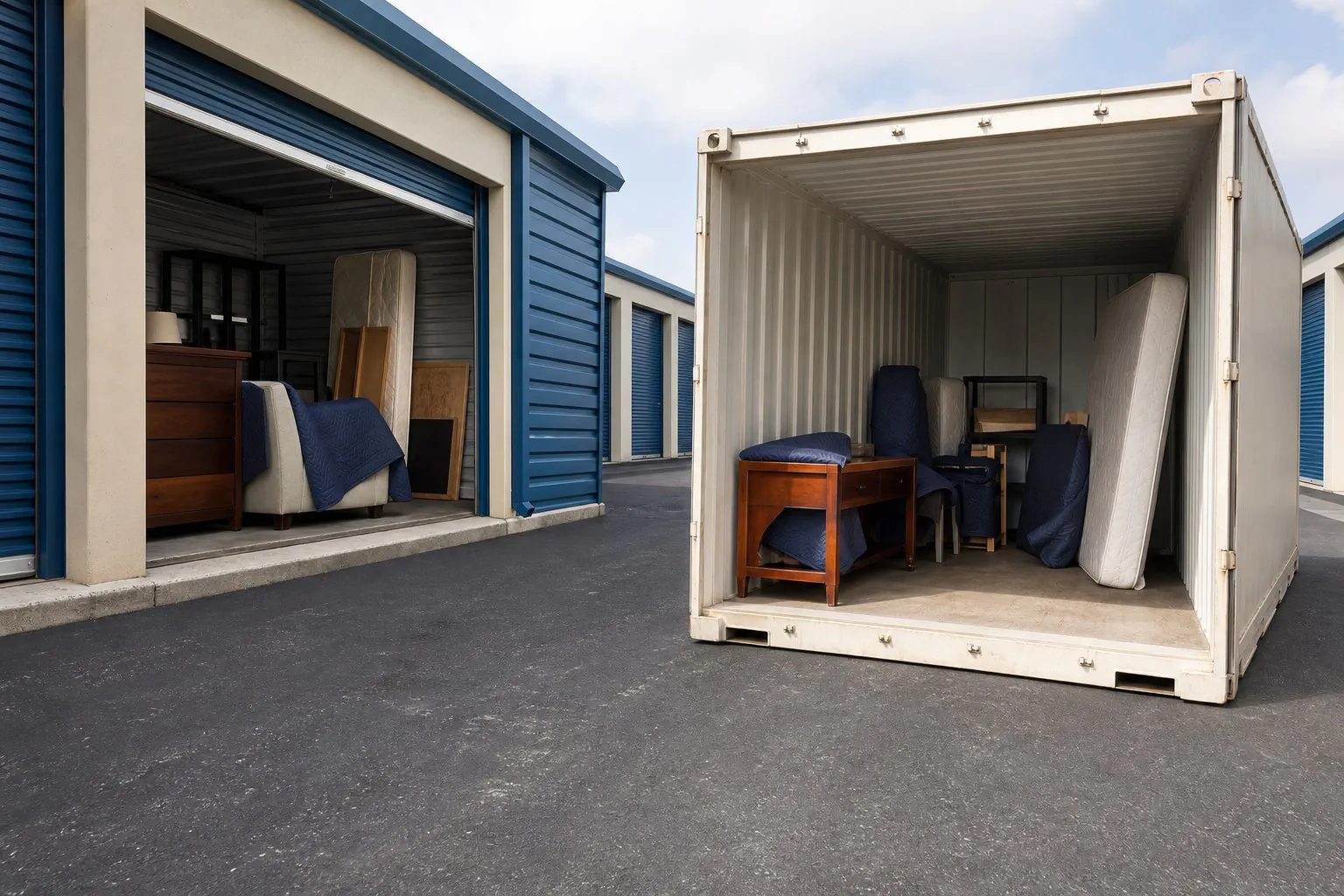
How do self-storage units compare to moving containers for storing my belongings during a move?
A practical side-by-side of self-storage units and portable moving containers during a move, covering access, cost, loading work, climate control, and when each option actually wins.
A self-storage unit is usually cheaper, offers more sizes, and gives you 24/7 access, but you load and unload everything twice. A moving container is dropped at your driveway, loaded once, and can ride with you to the new home, but the company controls pickup timing and the price runs higher. Choose a storage unit for local, short-term, or long-term gaps; choose a moving container when you need storage and transport together, especially for a long-distance or staged move.
The short answer
Self-storage units and moving containers solve different problems, even though both hold your stuff. A self-storage unit is a rented room at a facility you drive to. A moving container is a portable box a company drops in your driveway, then hauls away on its schedule. The right pick depends on how far you are moving, how long you need to store, and how much loading work you want to do.
How each option actually works
A self-storage unit is a rented room, locker, or parking space at a storage facility. You sign a month-to-month contract, get a gate code or key, and drive over whenever you want to add or remove items. Many facilities offer climate-controlled units, drive-up access, and a range of sizes from small 5x5 lockers up to 10x30 rooms that hold the contents of a large home.
A moving container, sometimes called a portable storage pod, is delivered to your home. You load it on your own schedule, usually over a day or two, then the company picks it up and either delivers it to your new address or stores it at its facility. Well-known providers include PODS, 1-800-Pack-Rat, U-Pack, Zippy Shell, and U-Haul, and available sizes typically run from about 8 feet to 16 feet long.
Side-by-side comparison
Self-storage unit vs. moving container
Feature
Self-storage unit
Moving container
Where it lives
At a facility you visit
Delivered to your driveway, then hauled away
Contract
Month-to-month, often 24/7 access
Per-move or per-month; company schedules pickup
Loading work
Twice: once into the unit, once back out
Once at origin, then the company transports it
Typical sizes
5x5 lockers up to 10x30 rooms
8-foot to 16-foot portable containers
Climate control
Often available
Generally not
Access to your stuff
Visit the unit on your schedule
Limited while it sits in the company's yard
Best for distance
Local or same-city moves
Local, long-distance, and staged moves
Cost
Generally lower
Generally higher, especially for long hauls
Best use case
Gap between homes, seasonal storage, downsizing
Long-distance moves, renovations, gradual packing
When a self-storage unit is the better fit
Pick a storage unit if you can check several of these boxes:
You need storage for less than a month or more than three months, with no fixed end date
You are moving locally and the new place is a short drive away
You want to drop by the unit on weekends or evenings to swap out seasonal items
You are storing sensitive items like wood furniture, instruments, artwork, leather, electronics, or important documents
Budget is the deciding factor and you want the lowest monthly rate
You are staging a home, downsizing, or clearing rooms before a listing
A climate-controlled indoor unit is the safer pick for anything that reacts to heat, cold, or humidity, especially if the unit will sit through a hot summer or a cold winter. A drive-up unit is easier to load and unload with bulky furniture and mattresses, but most drive-up units are not climate controlled, so they are better for durable items or short stays.
When a moving container makes more sense
Pick a moving container if you can check several of these boxes:
You are moving to a different city or state and want one load, one trip
Your closing dates do not line up and you need storage in between
You want extra packing time and a slower loading window than a single moving day
You are renovating or staging and need the box to sit at your home for a few weeks
You would rather pay for loading once than load a truck, unload into a unit, then reload another truck
Your new place is not ready, but the box can just stay on the company's lot until it is
The trade-off is control. Once the container is picked up, the company drives the schedule. You usually cannot add items, swap boxes, or swing by the storage yard the way you can with a self-storage unit. Pricing also varies widely by company, distance, and how long the container sits in storage, so it pays to get a written quote that lists monthly storage, transport, and any pickup or delivery fees separately.
Costs and contract terms to compare
Before you sign anything, confirm these line items in writing:
✓
Monthly rate and what it includes
Ask whether climate control, insurance, and 24/7 access are part of the base price or an add-on.
✓
Container pickup and delivery fees
Most moving container companies charge per trip, and long-distance transport is priced separately from the local delivery drop.
✓
Storage duration rules
Some container companies include a set number of free storage days, then bill monthly. Self-storage is usually month-to-month with no commitment.
✓
Access while in storage
Self-storage typically lets you visit any time. Container storage usually does not, unless the box stays on your property.
✓
Size and weight limits
Storage units come in many sizes; containers come in a few fixed sizes. Picking the wrong one either wastes money or forces a second box.
✓
Cancellation and move-out terms
Storage units usually have a short notice period. Container contracts may charge a fee if you cancel the transport leg.
A note on federal rules and in-state moves
A simple way to decide
Use this quick decision path:
01
Are you moving more than 100 miles or out of state?
Lean toward a moving container so your stuff loads once and rides with you.
02
Do you need access to your items while they are stored?
A self-storage unit wins here, especially with 24/7 gate access.
03
Are you storing anything sensitive to heat, cold, or humidity?
A climate-controlled self-storage unit is the safer default; containers are usually not climate controlled.
04
Is the gap between homes more than a few days but less than a month?
Either works. Compare the total cost, including delivery fees and monthly storage, before you commit.
05
Is budget the deciding factor?
Self-storage is almost always cheaper. The extra cost of a container buys convenience and transport in one package.
SUMMARY
The bottom line
Pick a self-storage unit for local moves, short or long gaps, anything that needs climate control, and situations where you want to walk in and grab a box whenever you like. Pick a moving container for long-distance moves, staged packing, renovations, or any time you want your stuff to load once and travel with you. The biggest mistake is treating them as interchangeable, because the cost, the loading work, and the access you get are all very different.
Common questions
Before you move on
Which is cheaper, a storage unit or a moving container?+
Self-storage is almost always cheaper on a monthly basis. Moving containers cost more because you are paying for delivery, pickup, and transport on top of storage. For a long-distance move, however, a container can be cheaper than paying for a storage unit plus a separate moving truck.
Can a moving container sit in my driveway for a few weeks?+
Most moving container companies allow on-site storage for a set number of days as part of the rental, and some let you extend it for a monthly fee. Check local rules and your lease or HOA, because some cities and neighborhoods restrict driveway containers.
Do I need a climate-controlled storage unit for a few months?+
For wood furniture, instruments, artwork, photographs, leather, electronics, books, mattresses, and important documents, climate control is worth the extra cost if the unit will sit through a hot summer or a cold winter. For durable items and short stays, a standard unit is usually fine.
How many times do I have to load my stuff with each option?+
With a self-storage unit, you load the moving truck, unload into the unit, then load the truck again when you move out. With a moving container, you load once at your current home and unload once at the new one. The container does the rest.