Can my moving company also store my stuff, and how does that storage-in-transit service work?
Yes, most full-service movers can hold your belongings. Here's how storage in transit, warehouse vaults, and portable containers differ, what they cost, and what to confirm before you sign.
Most full-service moving companies can store your belongings, either in their own warehouse or through a partner facility, but labor-only movers typically cannot. The three main options are storage in transit (a few days up to 90 days, often bundled into the move), warehouse or vaulted storage (months to years, billed monthly per vault), and portable containers (flexible timeline, no standard minimum). Your rights, including the right to retrieve your belongings, are protected under federal interstate rules when your move crosses state lines, while an in-state move is governed by your state's moving and storage regulations instead.
Full-service moving companies can almost always store your belongings, either in their own warehouse or through a partner storage facility. Labor-only movers, who simply load and unload a truck or container you arrange, typically do not offer storage. If you need both transport and a holding period, confirm storage availability before you book, and ask which type the mover provides.
The three storage options most movers offer
Movers usually frame storage in three ways. They solve different problems, and the one you pick should match your timeline more than your budget.
Storage in transit vs. warehouse storage vs. portable containers
Feature
Storage in transit
Warehouse storage
Portable containers
Best for
Short timing gaps between leases or closings
Extended transitions such as selling before buying or long renovations
Do-it-yourself moves, home staging, or gradual downsizing
Typical duration
A few days up to 90 days
One month to several years, by contract
Days to months, with no standard minimum
Typical cost
Often bundled into the move, or a daily rate
Around $100 to $300 per vault per month
Roughly $150 to $450 per container per month, plus delivery and pickup fees
How storage in transit actually works
Storage in transit, usually shortened to SIT, is the simplest option. Your belongings stay on the truck or are moved into a secure warehouse bay at the mover's facility while you wait for access to your new home. The charge is often folded into your moving estimate, or billed as a daily rate on top of it. SIT is built for short, predictable gaps: a lease that ends Friday before your new place is ready Monday, a closing that slips a week, or a renovation that needs the rooms empty for ten days.
The catch is the 90-day ceiling. SIT is meant to be temporary, and most movers will ask you to transition to warehouse or container storage if your timeline stretches past that point, often at a different rate and contract.
When warehouse or vaulted storage makes more sense
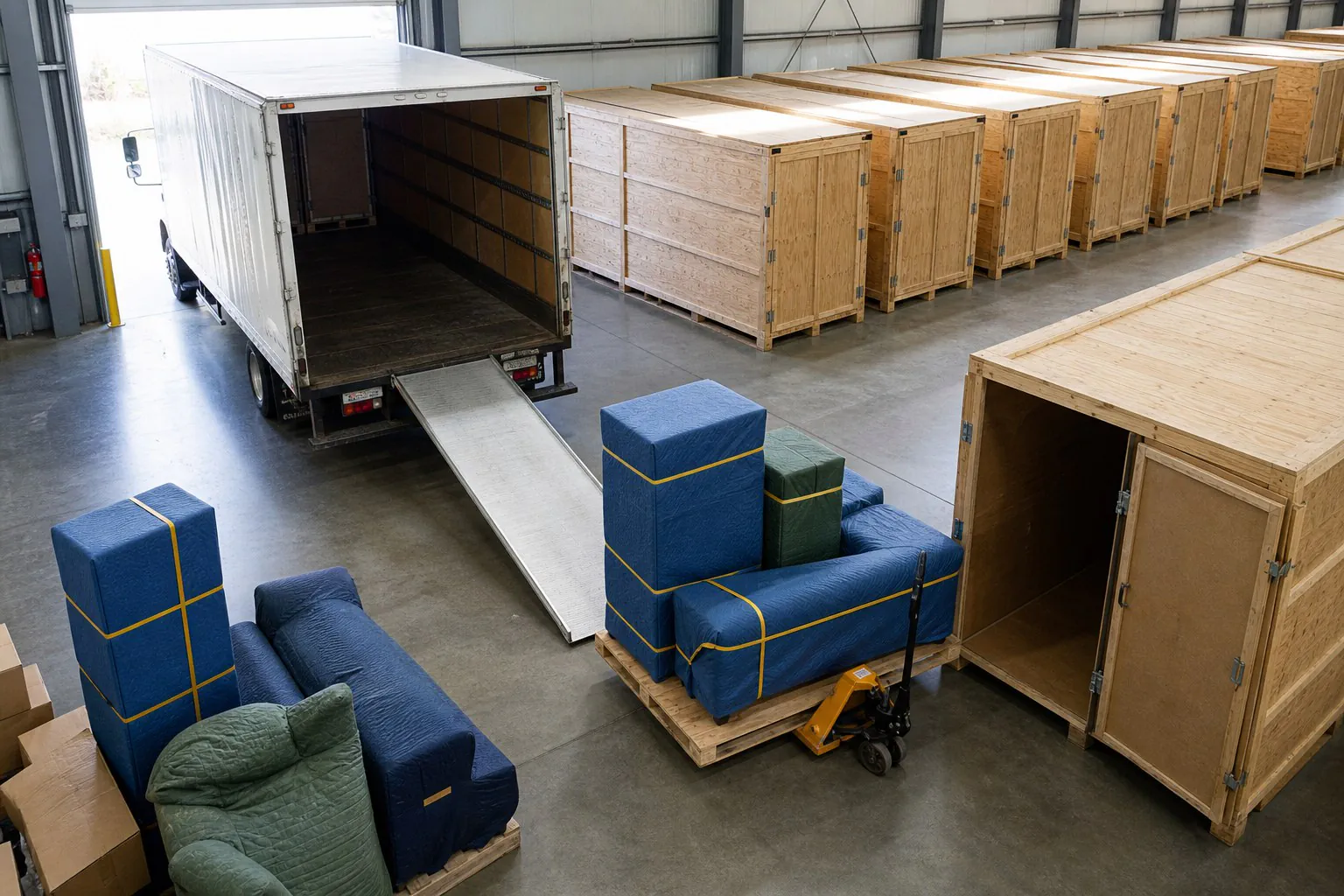
If you are selling before you buy, managing a renovation that will take months, or handling a long-distance move with a delayed delivery, SIT is the wrong tool. Warehouse storage is the long-form option: movers pack your items into wooden vaults at their facility, often climate controlled, and store them for as little as a month or as long as several years.
Pricing is usually per vault per month, generally in the $100 to $300 range, with possible one-time handling fees at drop-off and pickup. The advantage is single-vendor accountability: the same company that packed and transported your things is also storing them, which simplifies claims if something goes wrong.
Where portable containers fit
Portable containers blur the line between moving and storage. The company drops a container at your home, you load at your own pace (or hire movers to help), and the container either stays on your property for as long as you need it or gets picked up and moved to a facility. Most providers do not enforce a minimum rental period, which makes this option useful when your timeline is genuinely uncertain or you are staging a home for sale.
The trade-off is cost and handling. Containers typically run $150 to $450 per month, plus delivery and pickup fees, and you may end up loading and unloading twice if the container is moved to a warehouse and back.
What drives the final bill
Common pricing factors across all three options
Volume of belongings: a studio's worth of boxes costs far less than a three-bedroom household.
Duration: most facilities charge monthly and do not prorate, so one extra day can trigger a new month.
Climate control: useful for wood, books, instruments, and electronics, often adds $100 to $200 per month.
Geography: urban warehouses price higher than rural ones.
Insurance: extra coverage typically runs $10 to $30 per month on top of base liability.
Access visits: some facilities charge $10 to $25 each time you stop by.
Labor: help loading or unloading runs roughly $50 to $100 per hour.
Red flags that should make you walk away
Stop and find a different mover if you see any of this
✓
Demands a large cash deposit or full payment up front
Reputable movers bill after delivery or on a clear schedule, not before work begins.
✓
Only gives verbal quotes
Insist on a detailed written estimate with line items for storage.
✓
Cannot show proof of licenses and insurance
For interstate moves, an active USDOT registration is non-negotiable.
✓
Skips the formal inventory at pickup
Without an itemized list, damage claims become very hard to win.
✓
Restricts or denies access to your stored items
You should be able to check on or retrieve your belongings during the contract period.
✓
Adds surprise fees or threatens to hold your shipment
This is a classic hostage-goods pattern and is illegal under federal interstate rules.
When federal interstate rules may not apply to your move
Questions to ask before you sign a storage contract
Confirm these details in writing
01
Which storage type is being offered
Warehouse vault, portable container, or SIT, and whether the storage is in-house or at a partner facility.
02
Contract length and exit terms
Minimum duration, monthly fees, early retrieval policy, and whether storage converts to a different rate if you go past 90 days of SIT.
03
Access during storage
Whether you can visit, how often, whether there is a per-visit fee, and how much notice you must give.
04
Liability and insurance
Whether you have released-value coverage or Full Value Protection, and what the mover's liability is for items in storage versus in transit.
05
Inventory and documentation
How items will be inventoried at pickup and how vaults are sealed and labeled.
06
Cancellation terms
What happens to your deposit and any prepaid storage if your timeline changes.
Verifying a mover before you hand over your things
Background checks worth doing once
Confirm active interstate registration with the FMCSA and USDOT if your move crosses state lines.
Read recent reviews across multiple platforms, not just one site.
Check the Better Business Bureau record and search your state attorney general's complaint database.
Ask for references from recent storage customers with timelines similar to yours.
Document your belongings with photos or a video walk-through before move day, and keep that file outside the mover's custody.
When using a mover for storage actually makes sense
Bundling storage with your mover pays off when the gap is real and the timeline is tight. Selling a home before the next purchase is closed, a multi-month renovation, a long-distance relocation with delayed delivery, or even a week between leases all benefit from one vendor handling packing, transport, holding, and final delivery. The cases where it makes less sense are very short gaps you can bridge with a friend's spare room, very long holds where a dedicated self-storage unit is cheaper, or moves where you want to spread the work across multiple providers.
SUMMARY
The bottom line
If you need a holding period, your mover is a reasonable single point of contact, provided they offer the right type of storage for your timeline. Use storage in transit for gaps under 90 days, warehouse vaults for anything longer, and portable containers when you need loading flexibility. Get the storage terms in writing, confirm the mover's licensing for your type of move (federal for interstate, state for in-state), and remember that on a local move, your state's rules, not the FMCSA's, define what the mover can and cannot do with your shipment.
Common questions
Before you move on
How long can a moving company store my belongings?+
It depends on the storage type. Storage in transit is designed for gaps of a few days up to 90 days. Warehouse or vaulted storage can run from a single month to several years, depending on your contract. Portable containers have no standard minimum and can be kept for days or months.
Can a moving company legally put my things in storage without my permission?+
Under FMCSA rules for interstate moves, a mover can place your shipment in storage at your expense if you are not available or cannot pay the agreed charges at the agreed delivery time. If you have paid in full and the mover still refuses to release your items, that can be considered holding your goods hostage and may violate federal law. For in-state moves, the equivalent rules come from your state's moving and storage regulations, and the right complaint channel is usually your state attorney general.
Is storage cheaper if I get it from my mover or from a self-storage facility?+
Self-storage units are generally the cheapest option, often $75 to $300 per month for a medium unit, but you handle all the loading and unloading. Warehouse storage through a mover typically runs $100 to $300 per vault per month, and portable containers usually fall between $150 and $450 per month plus delivery fees. The mover-provided options cost more because the company is also handling the transport and accountability.