Quick Facts
- Project: Casa Eme (Madrid, Spain)
- Architect: gon architects
- Total Area: 108 m² (approximately 1162 sq ft)
- Design Strategy: Chromatic zoning using primary colors instead of physical walls
- Central Anchor: A communal social kitchen with preserved original IPE wood flooring
- Key Concept: Replacing traditional fragmented corridors with fluid experiential sequences
- Visual Goal: Creating unobstructed sightlines to increase perceived spatial depth
When designing open concept floor plans for small homes, the focus should shift from merely removing walls to choreographing a sense of movement. To make a small open-concept home feel larger, designers should prioritize visual continuity and unobstructed sightlines through the use of consistent flooring and chromatic fields rather than physical barriers. This approach, exemplified by the Casa Eme project, allows light to penetrate deep into the floor plan while clearly defining functional areas through color and material transitions.
Rethinking the Corridor: Spatial Sequencing and Flow
In many traditional small house plans under 1000 sq ft, the corridor is often treated as a wasted "non-place"—a dark, narrow passage that serves only as a connector. At Casa Eme, gon architects reimagined this necessity by transforming a fragmented and disjointed layout into a fluid spatial sequence. Instead of being hemmed in by doors and walls, the interior circulation is dictated by what we call chromatic zoning.
The journey through the home begins with a vibrant yellow corridor. This isn't just a color choice; it is a tool for zoning techniques for open plan small apartments. The yellow acts as a compression zone, a bright and welcoming threshold that prepares the inhabitant for the expansive living areas ahead. By using such a bold hue, the architects define the entry sequence without the need for a single swing door.
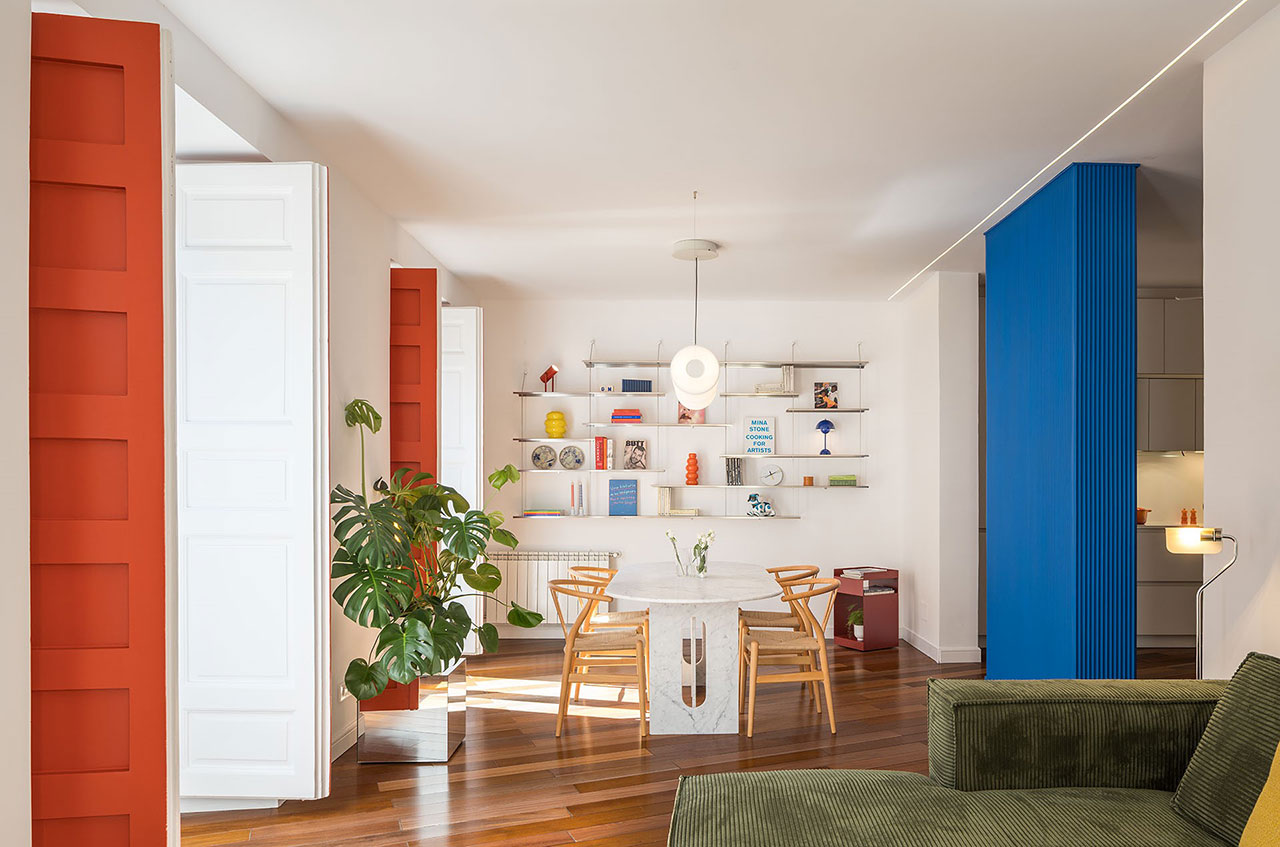
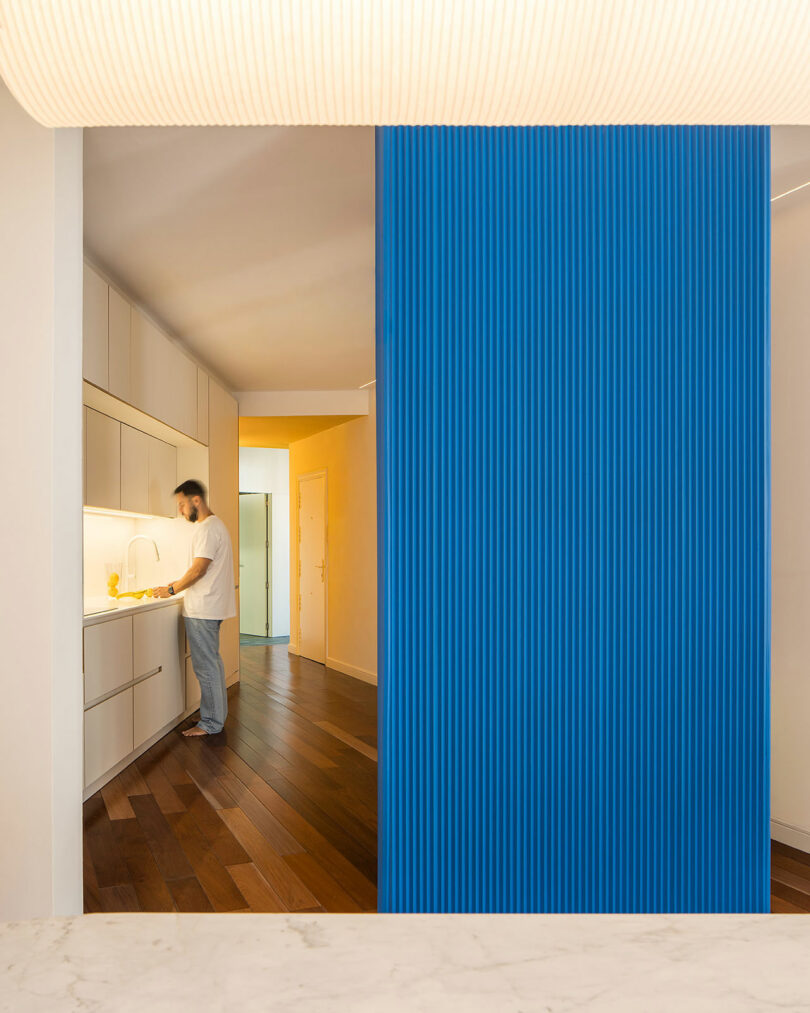
Beyond the yellow entrance, the space opens into a blue-clad acoustic unit. This volume serves a dual purpose: it houses private functions and acoustic insulation while acting as a visual anchor that guides the eye toward the living room and the views of the Plaza Mayor. This strategy of renovating small apartments for open flow ensures that even in a compact footprint, the home feels like a series of interconnected experiences rather than a series of boxes.
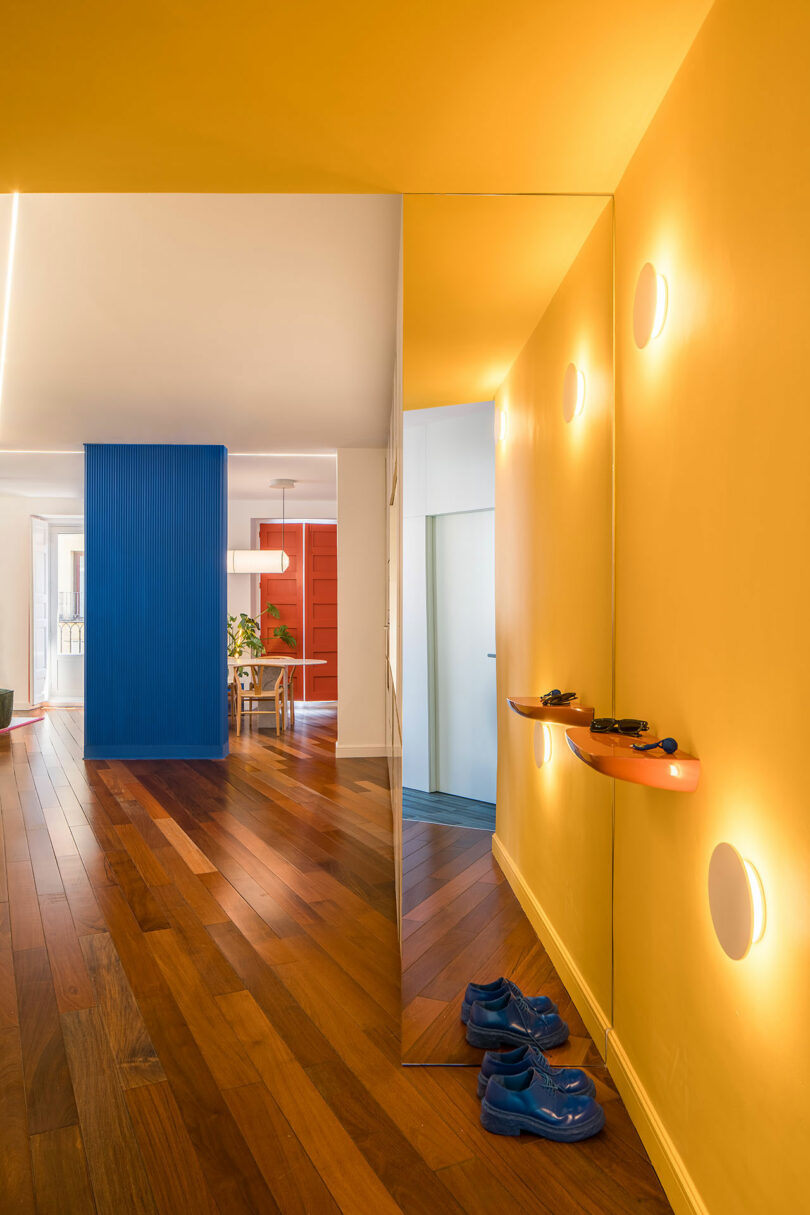
The removal of non-structural partitions allows light to travel from the large exterior windows through to the deepest parts of the apartment. When the eye can travel further without hitting a solid boundary, the brain perceives the space as being significantly larger than its actual square footage.
The Kitchen as a Social Hub: Eliminating Redundancy
In modern open concept floor plans for small homes, the kitchen is no longer a tucked-away utility room. It has become the gravitational center of the household. Casa Eme establishes the kitchen as the communal hub and social heart of the home, strategically positioned to bridge the gap between the dining and living areas.
This layout eliminates redundant corridors and small, unused corners that often plague simple open concept floor plans for small homes. By integrating the kitchen into the main living volume, the design fosters more fluid interior circulation. The cabinetry is minimalist and often integrated into the walls, maintaining a sense of visual calm. When storage is hidden behind long, unbroken surfaces, it reduces the visual "noise" that can make a small room feel cluttered.
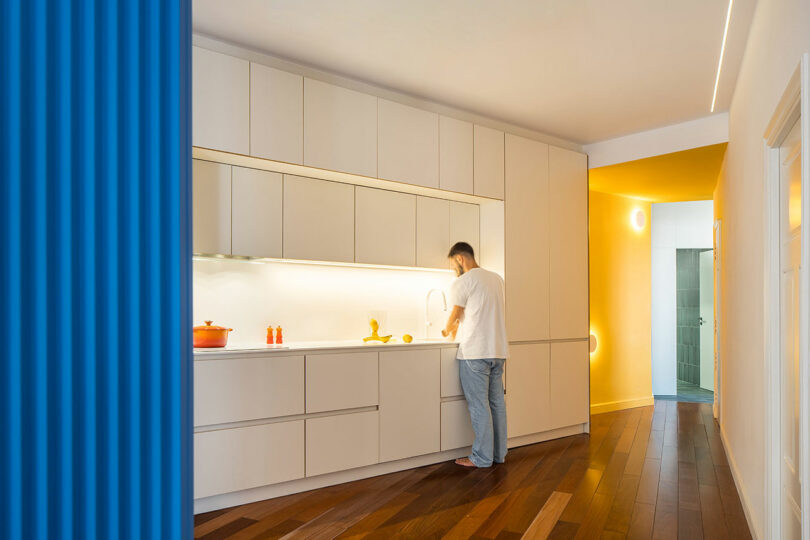
One of the most effective ways to maintain visual continuity in small house plans with interior pictures is through the flooring. In Casa Eme, the architects chose to preserve the original IPE wood flooring. This dark, rich texture runs continuously through the social heart of the home, acting as a grounding element. When the same material flows underfoot from the kitchen to the living room, it blurs the boundaries between rooms, tricking the eye into seeing one expansive hall rather than two separate zones.
| Measurable Thresholds | Recommended Standard | Casa Eme Application |
|---|---|---|
| Minimum Circulation Width | 36 inches | Exceeded via open-concept sequences |
| Window-to-Floor Ratio | 15% to 20% | Maximized through front-to-back sightlines |
| Zoning Strategy | Physical partitions | Chromatic fields (Red, Blue, Yellow) |
| Storage Integration | Freestanding units | Floor-to-ceiling built-in cabinetry |
Visual Multipliers: Light and Material Continuity
To truly master how to make a small open concept home feel larger, one must look at visual multipliers. These are the elements that expand the perceived boundaries of a room. At Casa Eme, this is achieved through geometric abstraction and architectural humanism.
The use of light-colored finishes on the walls and ceilings helps bounce natural light deep into the 108 m² apartment. However, the true brilliance lies in the front-to-back sightlines. By standing at the entrance, one can see all the way through to the red-framed shutters that overlook the historic square. This long-range view provides an immediate sense of depth that is often missing in standard apartment renovations.
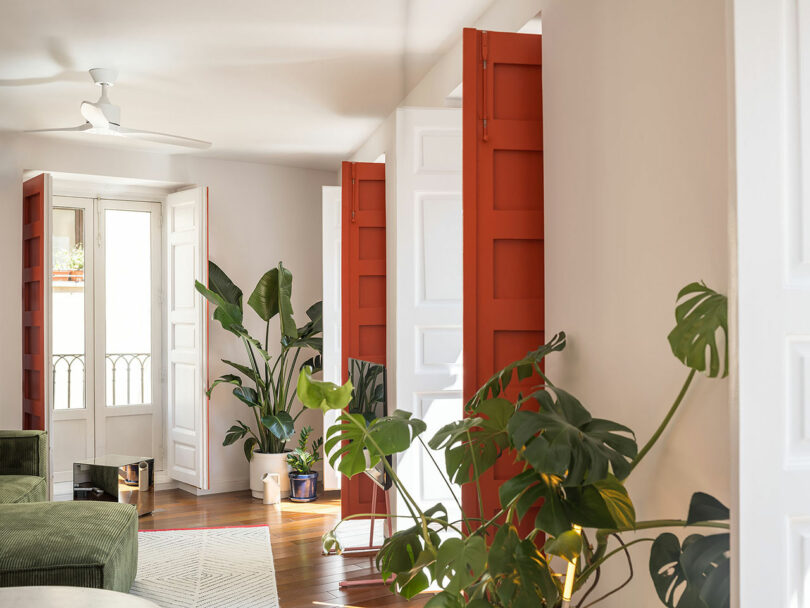
Natural lighting strategies are not just about the size of the window, but about what the window looks at. The red shutters at Casa Eme act as a framing device, drawing the eye outward. In modern small house plans with pictures, you will often notice that the most successful spaces are those that treat the exterior view as an extension of the interior floor plan.
Beyond light, material transitions play a vital role. In Casa Eme, the blue acoustic unit isn't just a different color; it introduces a different texture. This change in material signals a transition in function—from the public social hub to the more private, quiet zones—without the jarring interruption of a wall. This is a sophisticated way to manage adaptive reuse in older buildings, where the original structure may be rigid but the interior needs to feel modern and breathable.
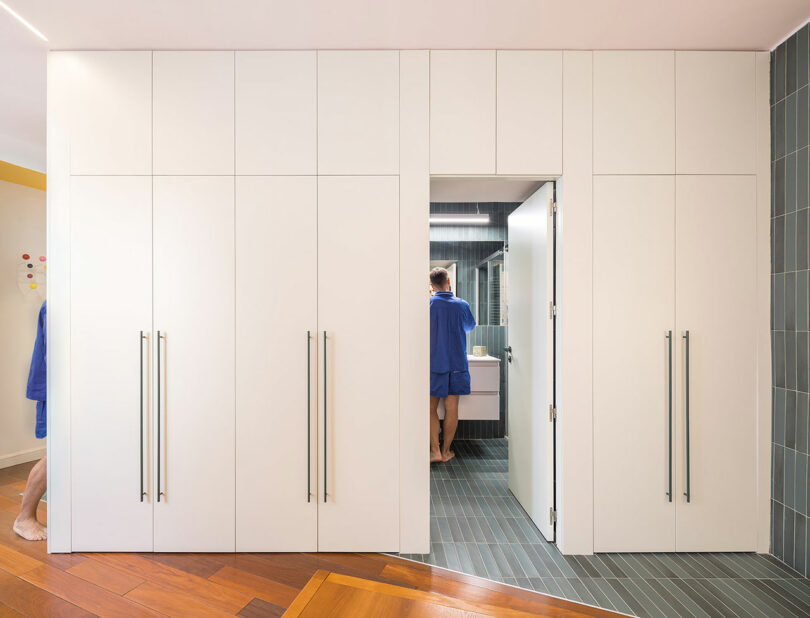
Integrating storage into these material "volumes" is essential for compact living. By hiding the fridge, laundry, and pantry inside the blue or yellow units, the architects ensure that the main living area remains an pristine, open space. This "hidden utility" is a hallmark of high-end modern house plans and is a lesson that can be applied to any small home renovation.
FAQ
How do you define different rooms in an open concept plan without using walls?
Zoning can be effectively achieved through chromatic fields and material transitions. By using distinct colors for specific areas—such as a vibrant hue for an entryway or a different textured material for a kitchen volume—you create functional boundaries that define a space without blocking light or air.
What flooring is best for making a small open concept home feel larger?
Visual continuity is key. Using a consistent flooring material across all interconnected rooms anchors the space and prevents it from feeling fragmented. In Casa Eme, preserved IPE wood flooring runs throughout the communal areas to create a seamless flow that makes the apartment feel significantly more spacious.
Why is the kitchen often placed in the center of small open concept layouts?
Converting the kitchen into a central social hub eliminates the need for redundant corridors. This arrangement allows for more fluid interior circulation and turns the kitchen into a bridge between dining and living zones, maximizing utility in homes under 1000 sq ft.
How can I increase the perceived depth of a narrow apartment?
Focus on creating unobstructed sightlines from one end of the home to the other. Using oversized windows and light-colored finishes helps bounce natural light, while strategic placement of furniture and the removal of non-structural partitions allow the eye to travel further, creating an illusion of depth even in compact layouts.
Is it possible to have a quiet space in an open concept home?
Yes, by using "acoustic units" or textured volumes. Designers can clad specific functional zones in sound-dampening materials or use colors like deep blue to signal a transition to a quieter, more private area, effectively separating work or rest zones from the social heart of the home.