We’ve all been there: the morning rush in a bathroom that feels less like a sanctuary and more like a high-stakes game of Tetris. You reach for the dry shampoo, only to knock over three bottles of lotion, while the hairdryer cord tangles itself around the faucet. In urban living, the small bathroom is an unavoidable inconvenience—a tiny, high-moisture footprint that demands we fit our entire self-care routines into forty square feet.
The psychological impact of bathroom clutter is real. When our surfaces are crowded, our brains register it as "visual noise," which increases cortisol levels right when we should be winding down or gearing up for the day. However, a small footprint doesn't have to mean small functionality. The secret to maximizing a small bathroom lies in three strategic pillars: utilizing vertical space with over-the-toilet shelving, installing floating wall shelves to preserve floor real estate, and employing over-the-door organizers to keep daily essentials accessible but off the counters.
Recent data suggests that this isn't just about aesthetics; it’s about perception. In fact, 92% of homeowners reported that clearing countertop clutter through the use of tiered organizers and hidden storage made their small bathrooms feel significantly more spacious. By shifting our perspective from horizontal surfaces to vertical and "hidden" zones, we can reclaim the calm.
1. Conquer the Vertical: Over-the-Toilet and High-Wall Shelving
The area directly above the toilet is perhaps the most undervalued "dead zone" in home design. Most standard bathrooms leave nearly five feet of empty wall space here, which is prime real estate for storage. Integrating vertical storage solutions like floating shelves or specialized over-the-toilet units can increase total storage capacity by up to 30% in bathrooms smaller than 50 square feet.
When considering over-the-toilet shelving hacks, the goal is to balance accessibility with a sense of lightness. If you choose a bulky, floor-standing unit, you risk making the room feel more enclosed. Instead, consider these approaches:
- Individual Floating Shelves: Installing two or three thick wood or glass shelves directly into the wall allows you to control the height. Place the bottom shelf high enough so it doesn't interfere with the toilet tank lid for maintenance.
- The Leaning Ladder: For a softer, more modern aesthetic, a leaning towel ladder provides a place for textiles and hanging baskets without the permanence of wall-mounted hardware.
- High-Wall Cubbies: Don't stop at eye level. Installing a shelf above the bathroom door or near the ceiling is the perfect spot for "back-stock" items—extra toilet paper rolls or seasonal products that you only reach for occasionally.
Sophie’s Pro-Tip: To avoid the "cluttered shelf" look, use the 60/40 rule. Fill 60% of the shelf with functional items (contained in uniform bins) and leave 40% as "white space" or for a single decorative element like a small plant. This keeps the room feeling airy rather than overstuffed.
2. Wall-Mounted vs. Freestanding: Choosing the Right Furniture
One of the most common questions I receive as an editor is: Should I use wall-mounted or freestanding cabinets in a tiny bathroom? The answer depends on your priority—floor space or storage volume.
Wall-mounted cabinets are the undisputed champions for small bathrooms because they free up "visual floor space." When you can see the floor extending all the way to the wall, your brain perceives the room as larger. Floating vanities or wall-hung linen cabinets create an architectural lightness that heavy, floor-based furniture simply cannot match.
However, if you have an awkward, narrow corner that isn't doing anything, a freestanding linen tower can be a lifesaver. These "slim-profile" units are often only 10-12 inches wide but stand six feet tall, providing a massive amount of storage for towels and toiletries in a footprint no larger than a dinner plate.
| Feature | Wall-Mounted Cabinets | Freestanding Towers |
|---|---|---|
| Best For | Creating the illusion of space | Maximizing total storage volume |
| Installation | Requires wall studs and hardware | Usually "plug and play" |
| Style | Modern, minimalist | Classic, transitional |
| Renter Friendly? | Usually not | Highly portable |
By opting for space-saving bathroom furniture that sits off the ground, you eliminate the "boxy" feeling of a cramped room. If you are stuck with a standard floor vanity, consider swapping the traditional kickboard for furniture legs to give it a "lifted" look.
3. Renter-Friendly Mobility: The Power of Rolling Carts and Adhesive Tiers
If you’re renting, you likely don't have the luxury of drilling into tile or replacing a vanity. This is where mobility and adhesive technology become your best friends. The best renter-friendly bathroom storage solutions are those that provide high utility without leaving a trace behind.
Narrow rolling carts are the "Swiss Army knife" of bathroom organization. A three-tier metal cart can slide into the six-inch gap between a toilet and a sink, holding everything from styling tools to cleaning supplies. When you need to clean or access the plumbing, you simply roll it out of the way.
For the shower, ditch the rusty over-the-showerhead caddy that never stays level. Instead, use adhesive-backed tiered shelves. Modern adhesive technology is incredibly strong and moisture-resistant, allowing you to place individual bins at the exact height you need.
- Adhesive Hook Systems: Use these inside cabinet doors to hang hair dryers, straighteners, or even wet washcloths.
- Tension Rods: A small tension rod placed inside a cabinet or under the sink can act as a "shelf" for spray bottles, hanging them by their triggers to clear up the floor of the cabinet.
- Acrylic Stackable Bins: These provide vertical bathroom organization inside deep drawers or on countertops, allowing you to see exactly what you have while doubling your usable surface area.
4. Unlocking Underutilized Real Estate: Doors and Recessed Nooks
In a small bathroom, every square inch must earn its keep. This includes the "hidden" real estate of your doors and the space inside your walls.
The back of the bathroom door is often ignored, yet it can hold a surprising amount of weight. A heavy-duty over-the-door mesh organizer with clear pockets is a game-changer for families. Each family member can have their own row for toothbrushes, combs, and skincare, completely clearing the vanity of daily clutter.
If you are in a position to do minor renovations, consider "recessing" your storage. A recessed medicine cabinet sits inside the wall cavity between the studs, rather than protruding out four inches. It’s a subtle change, but removing that protrusion from eye level makes the sink area feel significantly less claustrophobic.
For towels, think beyond the single rod. A multi-tier hotel-style rack allows you to store four or five folded towels on top while hanging two wet towels below. It utilizes the same amount of wall space as a standard rod but quintuples the storage capacity.
5. Intentional Decluttering: The 'Essentials Only' Audit
No amount of creative bathroom decluttering tips can save a space that is simply holding too much "stuff." Bathrooms are high-moisture environments, which are actually the worst places to store many of our common items.
I recommend an "Essentials Only" audit. Start by removing everything that isn't used on a daily basis. Medications, for instance, should actually be stored in a cool, dry place like a linen closet or kitchen cupboard—the steam from the shower can degrade their potency. Similarly, "back-stock" items (that 12-pack of toilet paper or the gallon-sized shampoo refill) do not belong in a tiny bathroom. Move them to a hallway closet or under-bed storage.
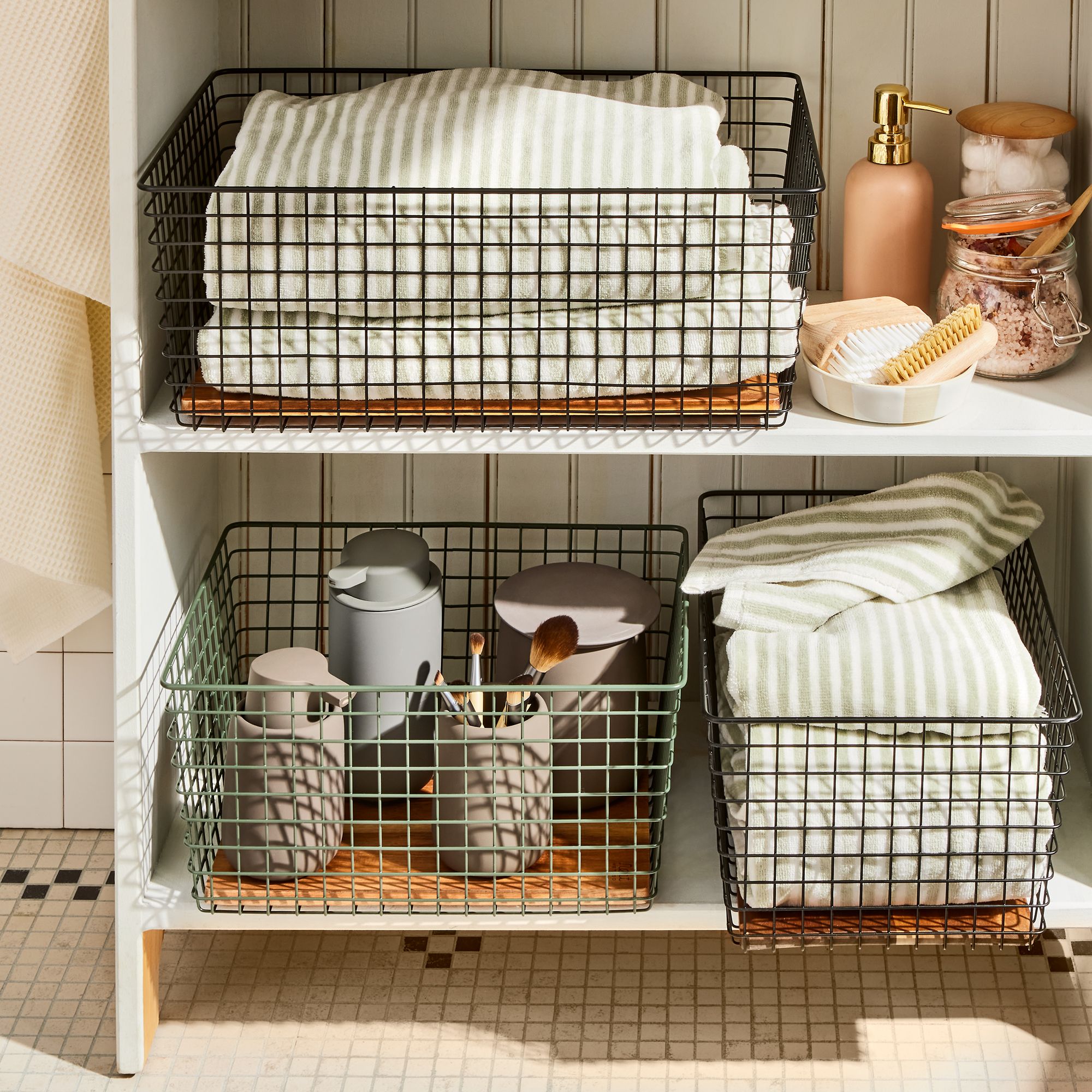
Once you’ve whittled your items down to the essentials, eliminate "visual noise" by using uniform storage containers. Transferring colorful, mismatched soap bottles and cotton swabs into glass jars or cohesive ceramic pumps creates a "spa-like" environment. When everything looks like it belongs to a system, the room feels organized, even if it’s small.
Expert Insight: "Visual clutter is the primary reason small bathrooms feel 'tight.' By decanting products into uniform containers and using opaque bins for miscellaneous items, you reduce the amount of information your brain has to process, making the space feel instantly larger." — Sophie Wang
6. Unconventional Remodeling Hacks: The 'Banjo' Counter and Beyond
If you are planning a refresh or a full remodel, there are structural "cheats" that can make a tiny footprint feel expansive.
One of my favorite design tricks is the "Banjo Countertop." This involves extending the vanity countertop across the top of the toilet tank. It creates a long, continuous line that draws the eye across the room, and it provides a much-needed ledge for a candle, a soap dispenser, or a small vase of flowers without taking up any additional floor space.
Other structural considerations include:
- Walk-in Showers: Replacing a bulky bathtub with a glass-walled walk-in shower opens up the sightlines of the room. A clear glass door (rather than a textured curtain) allows the eye to travel all the way to the back wall, instantly "doubling" the perceived size of the room.
- Toe-Kick Drawers: In custom cabinetry, the 4-inch space at the very bottom of the vanity (the toe-kick) can be converted into a shallow drawer. This is the perfect spot for flat items like bath mats, scales, or hidden cleaning supplies.
- Monochromatic Palettes: Using the same color for the walls, the tiles, and even the ceiling prevents the room from being "broken up" into small segments. A continuous color flow creates an expansive, airy feel.
FAQ
Q: How can I maximize storage in a small bathroom without it looking cluttered? A: The key is "containment." Use opaque bins or baskets to hide the mismatched bottles and tools. When you use vertical shelving, leave at least 30% of the shelf space empty to provide "visual breathing room."
Q: What is the most effective way to organize under a bathroom sink? A: Use tiered pull-out drawers or "lazy Susans" to reach items at the back of the cabinet. Since plumbing often gets in the way, expandable under-sink organizers designed to fit around pipes are essential for utilizing every inch.
Q: Are dark colors bad for small bathrooms? A: Not necessarily, but they require a different strategy. Dark colors can create a "jewel box" effect that feels cozy and intentional. However, if your goal is to make the space feel huge, light, reflective colors (whites, pale grays, or light blues) are more effective at bouncing light around.
Transform Your Sanctuary
Creating a functional, calm bathroom isn't about having the most square footage; it's about how you command the space you have. By moving your essentials off the counters and onto the walls, auditing your inventory, and choosing furniture that preserves your floor real estate, you can turn even the smallest bathroom into a high-functioning retreat.