Quick Facts
- Location: Saraiki, Latvian Baltic coast
- Architect: Open Architecture Design (OAD)
- Structure: 4 Soviet-era military bunkers repurposed into 3 buildings
- Primary Residence: 780 square meters bridging two bunker foundations
- Secondary Buildings: 2 guest houses with living grass roofs
- Material Palette: Fiber-cement cladding, metal frames, and glass-walled transparency
- Sustainability: Dune preservation and biotope protection through adaptive reuse
Located on the Latvian Baltic coast, the SAR residence is a masterclass in adaptive reuse architecture. Designed by Open Architecture Design, this project transforms four Soviet-era military bunkers into a glass-walled multigenerational home that respects the local dune biotope. By repurposing original defensive structures into a contemporary shelter, it serves as one of the most innovative adaptive reuse architecture examples in Northern Europe today.
The Military Foundation: Repurposing Soviet History
The coastline of Saraiki, Latvia, was once a landscape defined by defensive utility rather than domestic tranquility. Scattered across the dunes were remnants of Soviet military history—concrete bunkers designed to withstand heavy artillery, now standing as silent, weathered monoliths. For many developers, these structures represent a costly demolition hurdle. However, for Open Architecture Design (OAD), they provided the bedrock for a safe haven that bridges the gap between a traumatic past and a sustainable future.
The decision to embark on this military bunker home conversion was rooted in a philosophy of bunker archaeology. Rather than erasing the 1.2-meter thick concrete walls, the design team chose to treat them as historical artifacts that offer unparalleled structural integrity. By repurposing military structures for residential use, the project avoided the carbon-heavy process of massive excavation and new foundation pouring in a sensitive ecological zone. This approach transforms the psychological weight of the Cold War ruins into a sense of grounded permanence, allowing a multigenerational family to find security within the very walls once built for combat.
The project site originally featured four abandoned Soviet-era military bunkers which were strategically integrated into a cohesive compound. The architectural tension here is palpable: the bunkers are heavy, subterranean, and opaque, while the modern additions are light, elevated, and transparent. This dialectic is the hallmark of sophisticated adaptive reuse architecture projects, where the old does not just support the new but defines its character through contrast.
Structural Levitation: Bridging Heavy Concrete with Glass
Perhaps the most striking feature of the SAR residence is how it handles the weight of its history. The main residence, which spans approximately 780 square meters, is engineered to bridge the foundations of two original bunkers. This structural levitation creates a dramatic architectural silhouette where the primary living volume appears to float above the dunes, anchored by the concrete giants below.
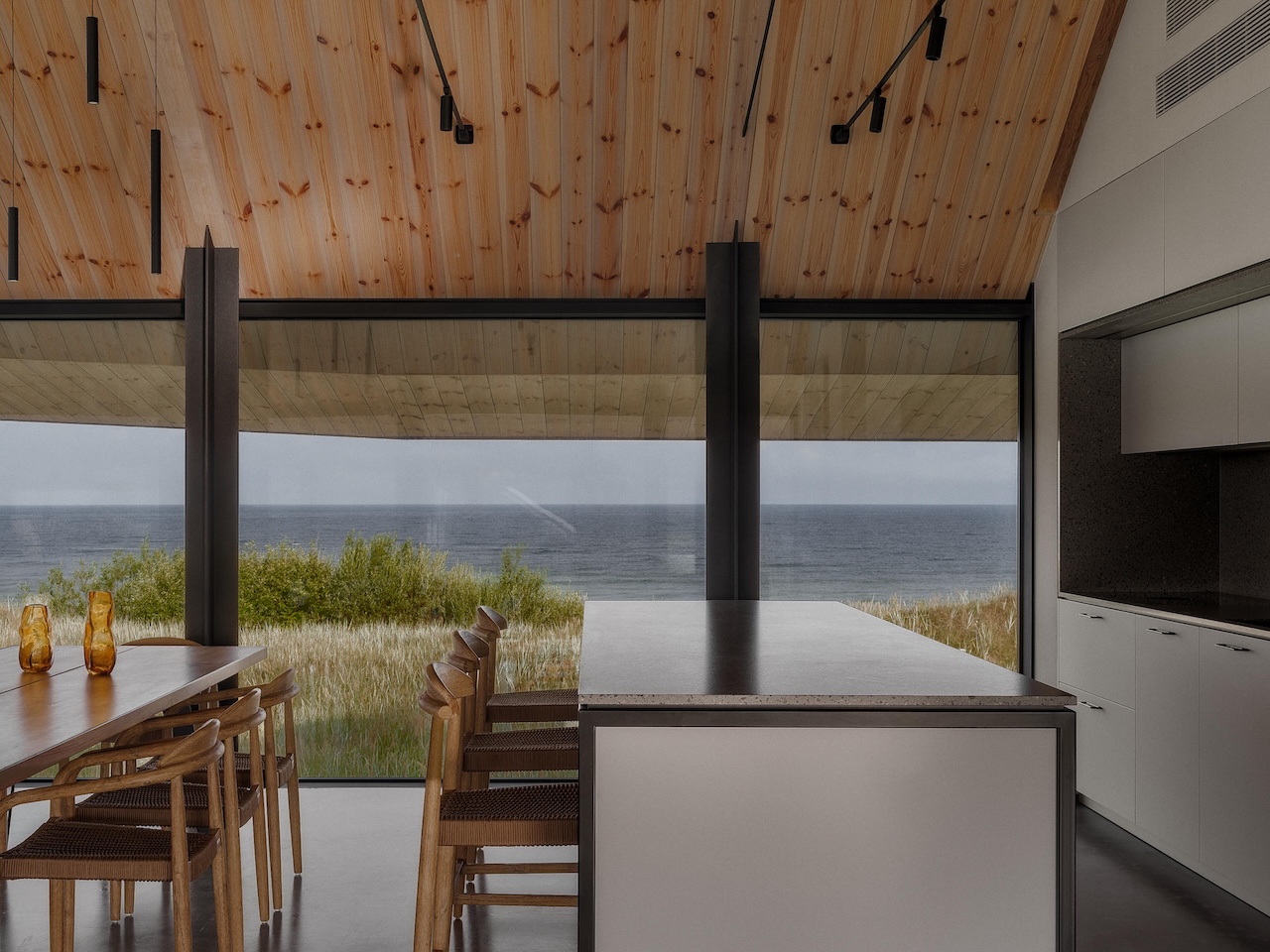
Capturing the sea horizon was a primary objective. By elevating the living area, the architects ensured that the Baltic Sea is visible from almost every corner of the main house. This elevation was achieved through custom metal frames and expansive glass-walled transparency, which serves a dual purpose. First, it allows natural light to penetrate deep into the interior, mitigating the inherent darkness of the bunker foundations. Second, it creates a visual lightness that prevents the 780-square-meter structure from overwhelming the delicate coastal landscape.
The architectural challenges of bunker conversions are often found in the rigidity of the existing forms. You cannot easily move a meter-thick concrete wall. OAD navigated this by using the bunkers as functional "anchors" for utilitarian spaces—storage, mechanical systems, and secluded retreats—while the new "bridge" structure houses the open-plan social areas. This creates a rhythmic transition between the cozy, protected feeling of the bunker interiors and the expansive, airy feeling of the modern glass pavilion. It is one of the most compelling modern residential adaptive reuse examples because it refuses to compromise on either protection or openness.
Material Harmony and Local Regulation Compliance
Designing on the Latvian Baltic coast involves navigating some of the strictest environmental and building regulations in Europe. To protect the coastal scenery, local codes often mandate specific roof types, such as dual-sloped structures. The architects at OAD used these constraints as a creative catalyst. By implementing a rhythmic, multi-pitched roofline, they were able to satisfy the regulations while creating a visual profile that mimics the undulating peaks of the surrounding dunes.
The choice of materials reflects a commitment to site-specific resilience. The exterior utilizes fiber-cement cladding, a material that pays homage to the industrial and military aesthetic of the Soviet era while offering modern durability against the harsh salt spray and wind of the Baltic climate. Inside, the design pivots toward tactile minimalism. Exposed metal frames and concrete are balanced with warm wood and soft textiles, creating an environment that feels sophisticated yet profoundly connected to the earth.
This project stands out among adaptive reuse architecture case studies for its focus on climatic mediation. The massive thermal mass of the original bunkers helps regulate indoor temperatures, while the high-performance glass of the upper levels maximizes solar gain during the long Latvian winters. Every material choice, from the metal bracing to the floor finishes, was selected to withstand the test of time, much like the bunkers that preceded them.
Ecological Integration: Living Roofs and Biotope Protection
Sustainability in this project goes beyond the reuse of concrete. The property is located on a stretch of coastline where the guest houses utilize grass-covered roofs to integrate with the protected dune landscape and minimize environmental impact. These living grass roofs act as natural camouflage, allowing the guest houses to virtually disappear when viewed from a distance or from the shore.
This commitment to dune preservation was essential for obtaining permits in such a sensitive biotope. By keeping the footprint of the guest houses within the original disturbed areas of the bunkers, the project avoided further encroachment into the native vegetation. The living roofs also provide significant ecological benefits, including stormwater management and natural insulation, further enhancing the compound's energy efficiency.
Coastal adaptive reuse architecture requires a deep understanding of the local ecosystem. At the SAR residence, the landscape is not just a backdrop; it is an active participant in the architecture. The transition between the manicured interior and the wild Baltic dunes is seamless. This project proves that adaptive reuse projects can be more than just historic preservation; they can be a form of environmental restoration, turning a scarred military site into a thriving, protected habitat.
FAQ
What is the meaning of adaptive reuse in architecture?
Adaptive reuse refers to the process of repurposing an existing structure for a use other than which it was originally designed. Instead of demolition, architects retain the structural shell and history of a building, such as a factory, church, or in this case, a military bunker, and transform it into something modern and functional, like a residence or office.
What challenges do architects face in adaptive reuse?
Architects often encounter rigid structural layouts, outdated building materials, and hidden environmental hazards like lead or asbestos. In bunker conversions specifically, the thick concrete walls make it difficult to install modern plumbing, wiring, and HVAC systems. Additionally, meeting modern building codes while preserving historical character requires innovative engineering and negotiation with local authorities.
Why is adaptive reuse considered sustainable?
It is a form of recycling on a massive scale. By reusing an existing structure, you significantly reduce the embodied carbon associated with new construction materials like steel and concrete. It also prevents demolition waste from entering landfills and often utilizes existing infrastructure, reducing the environmental footprint of the development.
What types of buildings are suitable for adaptive reuse?
Almost any structurally sound building can be a candidate. Common examples include old warehouses converted into lofts, grain silos turned into student housing, and decommissioned power plants becoming art galleries. The key is finding a structure with a "good bones" and a historical or aesthetic value that justifies the complexity of the conversion.
How does adaptive reuse impact historic preservation?
Adaptive reuse is often the only way to save historic buildings that are no longer viable for their original purpose. By giving a building a new life, it ensures the structure is maintained and funded. It balances the need for modern progress with the desire to keep the physical reminders of a community's history alive in the urban or rural landscape.
Conclusion: A New Life for Coastal Ruins
The SAR residence stands as a powerful testament to the potential of adaptive reuse architecture. By looking at the Soviet-era bunkers not as eyesores to be removed, but as foundations to be embraced, Open Architecture Design has created a home that is both a fortress and a sanctuary. It is a benchmark for how we can address the remnants of our past—repurposing them with dignity, innovation, and a deep respect for the natural world.
For those looking for adaptive reuse architecture examples that successfully marry history with high-end modern living, this Latvian coastal home provides the ultimate blueprint. It reminds us that sustainability is as much about the stories we choose to preserve as it is about the energy we choose to save. Through the lens of Lucas Reed, this project represents the pinnacle of energy-efficient, site-specific design that honors both the earth and our collective history.